site stats

Showing posts with label English. Show all posts

Monday, December 14, 2009

Write with Primary Terms

Michael Clay Thompson is the author of a fabulous but unconventional Language Arts program. He made a few interesting points in this video on vocabulary and writing.

I have always taught my boys to add adjectives and adverbs to their sentences when writing. So what Thompson had to say about these was quite a revelation to me... Well, can you tell I am not a language expert at all?!

Here are some of his points I have extracted from this particular video.

1. Plan A to writing and editing is to choose precise NOUNS and VERBS.
Don't try to rescue weak nouns and verbs with adjectives and adverbs.
If you aren't happy with your nouns, change your nouns. Not add an adjective.

If you see an adjective, kill it.
- Mark Twain

The adverb is not your friend.
- Stephen King

2. Wordiness is usually a modifier problem.
Modifiers add syllable counts and noise to a sentence; diluting interest level.

This kind of succinct writing reminds me of that advocated by William Strunk in The Elements of Style.

The Classics

Have you ever thought about reading the classics (either yourself or to your children) but shoved the idea because of the possible encounters with "old" words or expressions? Here is a list of classical words that you may want to be familiar with before taking the plunge.

I hope to work through these... somehow... ... ...

Wednesday, October 28, 2009

History : Patricians and Plebeians

I have Charlotte Mason to thank for being able to integrate reading, comprehension, writing, spelling, vocabulary and grammar into history and social studies. I rolled all that in within an hour of read aloud, discussion and written narration!

Well, this is just what we do regularly. Unconventional?... I know. But it works for us.

We are in the middle of our study of ancient Rome, using The Story of the Romans by H. A. Guerber as our spine. We covered the period of the Roman Monarchy (750-500 BC) and are now into the period of the Roman Republic ( 500 BC-0). I interspersed our readings with commentaries from our Truthquest guide. These commentaries put us into perspective regarding how all these history go in line with biblical principles.

Here is my boys' narration of the two chapters we read today:

The Wrongs of the Poor

The poor plebeians were ill-treated by the rich patricians. When the plebeians had not enough money to pay their taxes, they had to borrow from the patricians. When the plebeians had not enough money to pay the patricians, the patricians were allowed to take their land and even sell them as slaves or put them in prison.

When the people from another city, the Volscians, attacked them, the plebeians were forced to go to battle. They didn’t want to fight for the patricians because the patricians were ill-treating them. The patricians promised the plebeians that when they come back from fighting, rules will be changed so that they will not be ill-treated anymore. When they came back, the patricians didn’t change any rules.

The Fable of the Stomach

Since the patricians didn’t keep their promise, the plebeians ran away to a mountain known as Sacred Mountain. Both the patricians and the plebeians suffered. The patricians had no farmers to till their land, no market men to buy food from and no merchants to buy articles from. The plebeians had only brought a bit of food with them, so they were starving. Yet the patricians couldn’t persuade them to come back. So they sent a wise man named Menenius to try convince them to come back.

Menenius observed that the plebeians didn’t understand the patricians’ long speeches. He decided to tell them a simple fable to show the plebeians what the situation is. The fable was about body parts. All the body parts didn’t want to work for the stomach, so the stomach ended up weak. The other parts of the body soon grew weak too. When the plebeians heard this story, they understood that they were the other parts of the body and the patricians were the stomach. So they all went back to Rome.

After that, new rules were made that pleased the plebeians. Officers were appointed to take care of the needs of the plebeians. They were called the Tribunes. The Tribunes can veto any law that is not fair to the plebeians. That means the Tribunes could disagree and stop the passing of any law that is ill-treating the plebeians.

Monday, May 25, 2009

Horse Unit Study (part 4) - Horse Breeds

We are slowly soaking up all we can from our readings and making minibooks for our Horse lapbook as we are gathering new information.

We have been reading about various horse breeds in Album of Horses by Marguerite Henry. The history of the more common breeds are described in well-written prose. The language used is a little too sophisticated for my eight-year-olds. Even I am unfamiliar with many words that were used :-b But the information given is just too fascinating to miss. So I tried to get round the language problem by reading just a paragraph or two, then stop to discuss about what we can gather from that section. Many inferences had to be made and this skill has yet to be honed. Only after the discussion did I get my boys to narrate (just that section) while I type it out. It was a very slow process but I think it was good training.

Here is what we gathered about the Arabs:

Type of Horse: Riding Horse

Country of Origin : Arabian Desert

Size: 14.2 – 15h

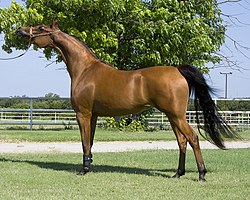
Colour : The Arab horses can be any colour but must have black skin underneath so that it can protect them from the sun’s ray.

Interesting Facts:

Arabian horses can survive on very little food. If there isn’t grass to graze on, they can eat dead locusts, bruised dates and dry herbs. Arabs are used for war. The Arabian fighters ride only the mares and they call them “Daughters of the Wind”.

The owners will always make sure that the mares mate with the best Arabian stallions so that the colt will be the best. The owners will let the horses drink camel milk even before their own family drinks. This is how well they treated their horses. The colts are given camel as stepmothers to nurse on.

There are two famous people who rode on Arabian horses. George Washington rode on an Arabian horse called Magnolia and Napoleon rode on one called Marengo.

Arabian horses have arched necks and high flung tails. Their bodies are slender. They are the oldest domesticated horse species in the world.

More of these little write-ups will be added into out lapbook as we continue to read about the other breeds. Although my boys wanted to read about ALL the breeds, I insisted that we at least first cover the Thoroughbreds, Shire, Lipizzan, Mustang, Appaloosa, Quarter Horse and Shetland Pony.

Tuesday, May 5, 2009

Horse Unit Study (part 2) - Picture Book Study

We did a Five-in-a-Row styled book study of a picture book Mrs. Mack by Patricia Polacco.

I chanced upon this book while I was searching for free lapbook templates on horses. I got all my teaching ideas from this page in homeschool share. I used most of the suggestions there and we learned loads! (More lessons plans for other books in this site! A treasure trove! We used most of the lapbook templates from the links on this page. I will post more about that in a separate post.)

I think this story is not one that will appeal to all readers. The subject matter is a serious one but written from the heart. It is an autobiography of the author's first experience learning how to ride a horse and the special relationship she shared with a horse, her riding coach and her riding friends. We read this book with great interest because our first riding experience was still fresh in our minds. I remembered being told to "keep my hands soft" and "don't hang on to the saddle horn!"- familiar words Mrs. Mack reiterated.

Wednesday, April 29, 2009

Changes for English

I found the First Language Lessons (FLL) by Jessie Wise a wee bit tiresome due to constant repetitions. And since I am already reading poems and requiring narrations, I found those lessons with these elements quite unnecessary. I have been wanting to discontinue FLL for some time.

So when a friend recommended Grammar Land by E. Nesbit, we immediately got hooked on it. This book is a very refreshing way to "study" grammar. It basically introduces the different parts of speech. It does so with a very engaging story. My boys will surely not forget rich Mr Noun and shy little Article, or how Adjective was tried for stealing from Mr. Noun.

I have just started out Rod and Staff English 3 (R&S), a book I was planning to use after FLL. Other aspects of Grammar (other than parts of speech) is covered here that I felt I still needed to address. I guess having come out from a system where grammar was "taught", I still cannot let go and trust that read aloud/copywork/dictation alone can do the trick.

Lessons in R&S English are short and manageable. I try to do most of the exercises that follow orally instead of assigning them as written work. That should help save some time.

Wednesday, April 22, 2009

A Poem : Centipede

In my opinion, the easiest way to learn to write is to see and hear the thoughts of a writer in the act of writing. As such, I see a lot of value in collaborative writing. When writing together, I can talk out how I choose words or phrases, and the "whys" and "how-tos" of editing and revising.

I expect that initially, the end product may tend to sound more like me than like them. To me, this is acceptable. It is my hope that gradually, they would internalize some of these methods I am using in my writing. Hopefully with time and practice, their own personal styles would emerge.

Here's our attempt at team composition:

I thought it would be interesting to write a poem about the centipede since we have a living specimen to observe. We brainstormed for adjectives that can be used to describe a centipede and for action verbs that centipedes normally engaged in. With this list of words, and with active looking out for rhyming words, we composed this poem.


Centipede

I am slimy.
I am tiny.
I'm a burrower.
I’m a wriggler.
I’m a segmented, many-legged,
Shiny armoured, mighty stinger.

People hate me.
Want me dead!
Stamp their feet
And hit my head.
So I scare them with a bite,
From my poison claws all right!

Monday, April 6, 2009

Start of Horse Unit Study

My boys have developed an interest in horses and I thought I should take this opportunity to do a Horse Unit Study. We don't normally do Unit Studies but I think doing it once in a while, maximizing on current interests, can be a nice break from our usual routine.

I have just started the Unit Study with a chapter book The White Stallions of Lipizza by Marguerite Henry (a Sonlight selection). In the second chapter of the book, we learned about the names of the Lipizzaner ballet routine. Here they are :
(We found video clips of each to better understand the moves.)

1. piaffe
2. levade
3. coubette
4. capriole

The complete Lipizzaner routine.

Here is our narration/description of these different stunts in poem form:

The Lipizzaner Routines

The white stallions of Lipizza
Will always bring shouts of "Bravo!"
They are trained to perform piaffes,
Levades, courbettes and caprioles.

A piaffe is a move,
In which the horse will trot
And never go forward
But stay on the spot.

If you see a horse on two legs,
You are looking at a levade.
The show horse is still.
Horses do this in a parade.

See the horse rear up
And hop on its hind legs.
A horse doing a courbette
Is like a horse dancing a ballet.

A leap! A kick
Of the hind legs in the air.
With all four legs off the ground,
The capriole is an act that is rare.

The white stallions of Lipizza
Will always bring shouts of "Bravo!"
They are trained to perform piaffes,
Levades, courbettes and caprioles.


Credits:
Second stanza on piaffe by B.
Third stanza on levade by D.
Fifth stanza on capriole collaboration between B and I.

As I am typing this, my boys are having a ball of a time on all fours, pretending to be horses and attempting these four moves... and yes it's even more fun with a rider on the back shouting out commands!

Tuesday, March 24, 2009

Cinquains

Most of the poems we read are in two of these usual forms:
1. couplets (aabb)
2. quatrain (abab)

My boys obviously enjoy poems that rhyme. They will always "complain" when we read a poem that doesn't rhyme. But recently, we came across a few that we rather liked. They were from a poem book called Butterfly Eyes and Other Secret of the Meadow by Joyce Sidman. (Thanks tjm! for the recommendation!) Quite a number of the poems are free form, and one particular one uses the cinquain form (unrhymed: 1 word, 2 words, 3 words, 4 words, 1 word... or 2 syllables, 4 syllables, 6 syllables, 8 syllables, 2 syllables... I found several definitions!). Sidman's poem were also all in riddles. That made it even more interesting for the young ones!

We thought this form sounded fun. My boys were inspired and subsequently came up with a few poems of their own using this form. Here is one by B (not strictly cinquain).

A ball.
A ball rolls.
A ball rolls into water.
A ball rolls into water and floats away.
Whoa!
Where did it go?

This one by B is a more strict syllablic cinquain.

Horses
Walk, trot, canter
And gallop. These are gaits.
They are different ways horses move
About.

More on B's blog :-)

Sunday, March 22, 2009

Getting into the Medieval Mood

This pass week was a mad week for us. We were in the thick of preparing for my boys' 8th birthday celebration.

Knights and castles. Swords and armour. Bows and arrows. Horses and dragons. My boys just LOVE everything about the middle ages.

So when I agreed to have their first ever birthday party, I decided we'll have a medieval themed one. (I have always heard about or read about people having themed parties but have never had or attended one! And they sounded so fun. I just have to try one!). I was at first a bit hung up about not timing it with our History studies. Should I do it next year instead? That's the perfectionist in me speaking. But I decided to be spontaneous about it. I just want to let my boys have fun!!!

We have shied away from having any parties previously because I wasn't sure I could handle the logistics of one. How to feed so many people? What to do with the children? Oh no! Have to plan games? How to entertain everybody?! ... So much work!!!

Then recently, I read about the wonderful birthday party a good friend of mine planned for her son. I was amazed at her dedication and creativity! I was really put to shame. Haha... in a good sense because I was all inspired after that. She spoke about making memories for her children and that set me thinking... It is just this few years really, may be between the ages of 6 to 12. I don't think a teenager would fancy one at all. It would be too "childish" for them then.

So here I am, going to give it a try ... starting really small with inviting only 3 families. Just don't think I could cope with more... :-b (Have already exceeded the rule of "number of friends to invite equals age of child" rule.)

I hope to do a crash course on History in the Middle Ages (just for this two weeks) ... just a bit of this and that. This would serve as an introduction for later studies. I just couldn't resist it. :-b

In order to get the boys into the mood (Like they needed help!?), I chose a book that is set in the middle ages for our read aloud. It is King of Ireland's Son by Padraic Colum. Reviews of the book revealed that some clever story-telling is exhibited in the weaving of stories within a story. I have been saving this book for when we are "there" for History, but have decided now is good enough! This book has been a page-turner so far. More a fun and fantasy type book rather than one that gives detailed introduction to that period in history. Nevertheless an enjoyable read.

These were the books I assigned for independent reading this week:
Saint George and the Dragon by Margaret Hodges
The Kitchen Knight by Margaret Hodges
A Medieval Feast by Aliki
If You Live in the Days of the Knights by Ann McGoverit

There are many more of such books. I just chose those I could get my hands on.

Monday, March 16, 2009

Poem Fever

My boys simply love poems. Every time I finish reading one, they will be begging for more. So we can seldom just read ONE poem (as recommended by Ambleside Online).

I have to confess that I have not been reading poems as regularly as planned. But I think not much "harm" was done. We will take it from wherever we are and start from there! I am now resolved to read at least 2 before our chapter book read alouds. This is just to ensure it doesn't get forgotten :-b

So here is what we are reading now. A wonderful book of poems arranged by subjects called Read-Aloud Poems for Young People: Readings from the Worlds Best Loved Verses by Glorya Hale. (Similar to the better known Favorite Poems Old and New by Helen Ferris.) I appreciated the extra biographical sketches provided about the poets which often heightened interest somewhat.

In fact, my boys have recently took to liking poetry so much that they have even started composing some themselves. They unabashedly claim to be "poets". (Well, if you write, you are a writer. If you draw, you are an artist. So in the same line of reasoning, since they write poems, they are poets! :-D I decided I didn't want to "burst their bubble"...)

I sometimes speak to them in rhymes just to show them that it really isn't that difficult to compose rhyming verses off the top of our heads. They are always very tickled whenever I do that and would be challenged to respond in similar rhyming verses! Sometimes we may end up with something nonsensical and have a good laugh.

I see value simply in their wanting to compose. In my efforts to encourage them, I felt I needed them to know that there is a place for nonsensical poems. This is where I found our collection of Edward Lear's Nonsense Poems useful. Read-Aloud Poems for Young People also has a section called Laughing Lyrics that my boys especially enjoy.

Do you have any poetry books to recommend?


I think this "poem" fever
is here to stay.
And will get hotter
and hotter each day! :-)

Tuesday, March 10, 2009

Art : Limbourg Brothers II - Book of Hours

One of the Limbourg brother's most famous work is the Book of Hours (Tres Riches Hueres) commissioned by the Duke of Berry. This book of prayer has prayers for certain times of the year, month, day or hour. The Limbourg brothers were responsible for richly illustrating the book. In it is a calender that had 12 pictures depicting various events within the year occurring in and around the Duke of Berry's castle vicinity.

I chose to conduct detailed Picture Study for the months of January, March, May and August in the Book of Hours. We viewed the rest of the paintings of the other months in this site just for fun.

These studies were followed by a creation of our own "Book of Hours". Basically, I just told my boys to draw a picture that is a representative event of the month of January or February this year. We added the semicircular outline on the top of our paintings to mimic the template used by the Limbourg brothers.

Here is B's January.


He wanted to remember the day when we went visiting during Chinese New Year. He brought our Rubik's cube along and was playing with it. He had then already been able to solve the cube without referring to the solution sheet. (Memorized the solution. I didn't think anybody could do that.) An uncle of mine was impressed and insisted on timing him. B solved the Rubik's cube within a staggering time of 1 minute 30 seconds!!! (D's best time was 1 minute 37 seconds.)


Here is D's February.


He wanted to remember the fun he had at the zoo when we first visited Kidzworld. This picture is of him pulling the rope on the raft.


I want to make a note here that my boys had really come a long way with respect to their painting. They still have lots of room for improvement, of course! I am just glad that they have more control of the brush now so at least they can get most of the paint within the lines. I attribute this improvement solely to the natural development of their fine motor skills. I have seen other little girls being able to colour or paint neatly at a younger age, and have always wondered why my boys can't seem to do that! :-( I have to constantly remind myself that every child is unique and they all have different developmental clocks.

I am also glad to see that they have applied what they have learnt from the lessons in Draw Squad to their drawing.:-) See the 3D cube and raft!

As an aside, ... ... ...

In the preschool years, I had tended to plan my lessons thematically. It worked then, but is a little too tedious for me at this stage when I have more specific topics to cover. However, selecting a few related poems or books was no trouble at all.

This is my attempt at riding on the theme of Calenders/Seasons.

We revisited the poem A Calendar by Sara Coleridge. This is a lovely poem that we seem to not get sick of relearning every year! We have a few versions of this poem in some of our poetry books but our favourite is from this book Eloise Wilkin's Poems to Read to the Very Young. This is a board book that I read to my boys since they were toddlers. The illustrations are lovely. In fact I caught my boys devouring it all over again during their free time.

For Chinese, I selected the book 春天的兔子 for our read aloud. The story tells of a rabbit's impatient wait for the arrival of his little siblings through the different seasons. A rare Chinese Living Book :-)


Visit Rumphius Webpage Art to learn more about how we approach Art in our homeschool.

Friday, February 6, 2009

Lessons From and On the Harvestman

One of our read aloud chapter this week was The Cheerful Harvestman from Among the Meadow People by Clara Dillingham. I really love how Dillingham weaves in moral issues in each of her chapters that also gives accurate information about the animal she is writing about. Her a"not-so-modern" phrases are a delight to my ears.

In this chapter on the harvestman, we learned the benefits of being good-natured even when teased by other, not to look down on others, how clever it is to "look dull" when others are gossiping, and be cheerful despite misfortune. The harvestman is really MY kind of guy!

For our "English lesson", this read aloud was followed by an oral narration and copywork.

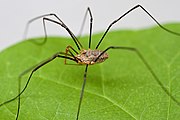
And since we haven't any idea what a harvestman was, we went on the Internet to check it out. We learned that a harvestman is also known as a "Daddy-Long-Legs". Many people mistakenly consider them to be spiders. They are in fact not true spiders. Their head, thorax and abdomen are grown together; having no "waist". They are not venomous. They neither spin webs nor build nests. Instead, they lay their eggs in the soil or under rotting wood. Unlike spiders, they can feed on dead or living prey. Vegetable matter and even juices are also part of their natural diet.

I found a website that gave information that is simple enough for my boys to understand. (Many others had too many scientific jargon.) We read this webpage together and created a table that shows the differences between a harvestman and a spider.

Tabulating information from a given narrative is in my humble opinion a very important and necessary study skill to hone. As such, this little exercise, although quite unrelated to our other studies (We have not gone into zoology yet!), was nevertheless a valuable one.

At the very least, we SHOULD be able to tell a harvestman from a spider... IF we ever encounter one in the future.

Wednesday, January 14, 2009

English Vocabulary

Last week, being the first week of school, was a rather hectic week for us ; new routines, new schedules and even some new approaches. Lots of re-evaluation and re-adjustments and re- scheduling at the end of each day.

My reason for doing this is that I have learned not to over-plan (still not very good at that!) and not to plan too far ahead.

My aim last week was to concentrate on the core subjects; English, Chinese and Mathematics. Get these going, then start adding other subjects into our day gradually.

The new element we added into our English is a vocabulary component.

There are times when we read a book and some words just baffle us. It would be just such a waste if we pass them by and never really learn what they mean. Of course there are times when we could guess the meanings of words from contextual clues but it is always nice to know exactly what those words mean and how they else they can be used.

As such, I have decided to include a vocabulary section to our English "curriculum". If you have been reading my blog, you would have noticed I have already done that previously. Just that I wasn't very organized about it :-b

Last week, one of our read aloud chapters was a chapter on Hermes from D'Aulaires' Book of Greek Myths. After an oral narration, a paragraph from page 54 was selected for copywork and dictation.

I selected this list for our Vocabulary List 1 :
wit
loft
lofty
precocious
toddle
grove
herald
glib
cairn
fond
(The following words were added into the list from our holiday readings!)
snug
schooner
scuttle
bunk
galley

I plan to continue to pick words from our read aloud chapters. 10 to 15 per week is nice to start with. I let my boys copy and paste from an online dictionary to a word document. I then print this sheet out for them to study from. I use the online matching game maker that I have found to create a matching game to test my boys after they have studied their words.

Here is our Vocabulary 1 Matching Game. This is a matching game for my boys' review. This is really easy to make since I just copy and paste from the word document that my boys have made.

This week, one of our read aloud chapter came from Skylar by Mary Cuffe-Perz.
Here is our Vocabulary List 2. Shorter this time ;-) :
preen
rouse
baffle
bray
ravenous
intimidate
reserve
rollicking
replenish
audible

This is their review game for this list:
Vocabulary 2 Matching Game

Note that this little vocabulary exercise is done on top of our usual read aloud, narration, copywork and dictation.

I have added all the online games I created in my link section on the side panel. In future, I will just add the links to new games there. This will makes it easier for me to just tell my boys to "Go play the vocab game!"


Visit Rumphius English Webpage to find out more about how we approach English in our homeschool.

Monday, December 29, 2008

Creating My Own Interactive Matching Games

In my post, The Kumon Method: How I Can Use It, I shared that I would want to find a free online site that allows me to type in my own matching games. I want to use this to administer Kumon style tests for the vocabulary lists we have in our English book.

These are the criterion I had for the game maker:
1. Have a pair and match format
2. Timed quizzes (nice to have but ok without)
3. Provide feedback to the learner.
4. Scramble question AND answer order each time the learner takes the same test.
5. Web-based
6. FREE

I had just found a site that meets 5 out of 6 of my criterion! Hooray!!!

The site is called "Create Your Own Interactive Games". I like the user interface here. It is easy to use and visually attractive. I have already created a game based on the study lists I have assigned my boys. You can try my Synonyms-1 Matching Game and my Places-1 Matching Game. I chose to enter 15 matching pairs but each games will only randomly select 8 pairs to test. That means you can play the same game repeatedly and they will not be exactly the same.

However, there are limitations. The fonts used in this site are big and cannot be changed. Thus, I could not type in longer idioms and proverbs. It still has its usefulness though for synonyms, antonyms, similes, vocabulary etc.

I continued my search....

And found a free down loadable program that is called "Matching Game Maker"
This program solved the font size problem. So I can now add in tests for idioms and proverbs. Yeah!! The game is saved on my computer so unfortunately I wouldn't be able to share it with you!

This game is also easy to set up. Although it is not as attractive as the former, it has the advantage of more words in each option, even allows for audio matches, AND allows Chinese characters! I will surely be tinkering around with this more...

I am quite please with these 2 matching game makers and they should meet my needs for now.

Sunday, December 21, 2008

Poem : At the Park

My little fellow decided he wanted to blog about our Friday outing at the park too (See my post Sunshine Rain and Friends).

I casually suggested that he try writing a poem instead of the usual narrative form. I gave him the first line and told him to find something that rhymes with "park". We brainstormed all the words that rhyme and then I asked him to come up with a logical continuing line. Subsequently, I asked him what else he wanted to write about, made him come up with a rhythmic sentence and then brainstormed again for rhyming words. We worked two lines at a time in this manner.

I was pleasantly surprised that the rest of the poem rolled out quite painlessly! (I helped with the second paragraph a little more ;-) because his syntax wasn't right at first.)

I must admit that I really like his poem a lot :-D. In the first place, it actually sounds like a poem. lol. And mainly because it really tells of the games he played at the park.

Here it is. Enjoy.


At the Park

My day at the park,
Climbing trees and peeling bark.
Playing golf,
With sticks and balls.

Bowling using sticks as pins,
Doing our best to see who wins.
Soccer was played by kicking balls,
Between goal-posts of trees so tall.

Running about,
Shouting so loud.
Stopping the games,
Only because it rained.

Monday, December 15, 2008

English - Copywork & Dictation : Skylar

I found an interesting book that would have tied in nicely with a unit study on birds (or read with Zoology 1 of the Apologia Series) ....accept that I am not currently having a unit study on birds. :-1 Oh well! A good book is always welcomed.

The book is Skylar by Mary Cuffe-Perez. This book is hot from the press; released in 2008! It is about a small group of pond geese who have never migrated before, watching wild Canada geese making their migration journey southward. By some chanced event, they were challenged to make their first attempt. The rest of the story tells the engaing tale of their adventure.

The style of writing reminds me of E.B. White's Charlotte's Web. Simply captivating.


Here is the paragraph I have selected for copywork:

Skylar, looking like a plump, feathered general, marched up and down in front of his small flock, inspecting, nodding and making curious clucking sounds. The announcement has been made: Skylar would lead the heron to Lost Pond, and he expected the four pond geese, as his flock, to follow. Now he waited for the excuses, complaints, refusal, which he was sure would come. He stared hard at each goose as if he meant to find a weakness and expose it.


These are the words my boys were to check the meanings of:
1. urban
2. peril
3. flamboyant
4. flouder
5. commotion
6. lurch
7. plummet
8. glower
9. flail
10. strode
11. intently
12. careen
13. strut

I used to let my boys check our big fat dictionary and copy the definitions. To save time, I am now trying out letting them cut and paste from an online dictionary, then print these vocabulary words out for them to study from. I found one at this site which suited my purpose.


Visit Rumphius English Webpage to find out more about how we approach English in our homeschool.

Thursday, December 11, 2008

The Kumon Method: How I Can Use It

I was browsing through the library shelves and came across this book "Every Child An Achiever: A Parent's Guide to the Kumon Method" by David W. Russell.

Reading this book has renewed my interest somewhat in the Kumon Method and its possibilities. It led me to rethink how I can use this method to my advantage.

Here's my plan to add a dash of Kumon in the 3 core subjects: Mathematics, English and Chinese. Essentially, I am looking at say 5 to 10 min a day per subject. This sessions will be perfect for much needed individual work during the times when I am busy preparing meals in the kitchen.

Mathematics

I am currently using a Math worksheet that already employs the Kumon method. Calculadders uses progressive math drill sheets that the learners have to complete. Each worksheet needs to be completed and their time taken to complete is jotted down. Learners can only move on to the next level when mastery has be attained. Mastery is indicated by completion of the worksheet in a specified time.

So far, I am quite happy with how the boys are progressing with Calculadders. I do find a big jump in some levels and intend to generate my own mid level worksheets to bridge the gaps. This, I felt were necessary to maintain high confidence levels.

My boys have reached the level of single digit multiplication (after completing 4 digit addition and subtraction). I have not really insisted on them memorizing their multiplication tables since I found that they can remember them just from repetition by attempting many of such sums. Skip counting has also eased the process.

Most of the multiplication sums goes like this (You can use the sums on this site if you do not have Calculadders.) :

3 x 5 =

3 x 8 =

I will want to add sums such as:

3 x ___ = 15

___ x 8 = 24

I know these are essentially using the concept of division. But I think it is important to make the link between the two right from the start.

I am encouraged that the founder of the Kumon method, Toru Kumon started out setting his own daily Mathematics sheets for his son. If he can do it, so can I! ;-) ... or anybody else for that matter!


English

At this lower primary level, I am mainly using the Charlotte Mason Method to teach English. However, I do see the need to supplement this method with more drills and even memorization. Let me explain.

[Be forewarned. If you are a Charlotte Mason purist. Don't read on! Because what I am about to describe would probably make you cringe.Hahaha...]

I was not an avid reader when I was in school. So, much of the vocabulary I learnt were learnt from lists that I was made to "study". (Did I hear you gasps?!... ) Do I believe in such an out-dated method? Well, the truth is that it has worked for me. I learnt the meaning of words (or idioms, proverbs etc. ) first, before I meet them in context when I did eventually pick up on my reading. I don't think my love for the English Language was smothered in any way.

I have an English grammar book published by Cosco. I like the lists of synonyms, antonyms, idiom, proverbs and such at the back of the book. I intend to let my boys systematically study these lists. I will attempt to make a series of worksheets that correspond to their assigned study list. They will have to score a perfect score on a worksheet (perhaps within in a specified time) before they move on to learn more.

I have been thinking how best I can administer these worksheets. I could do it the old-fashion pen and paper way. I found an online testmaker called Easy Test Maker that can help speed up my time in generating worksheets. There is a choice of multiple choice, fill in the blanks and matching.

I could also try to make Montessori 3-part cards. But this will be time consuming as well as of high material cost.

Alternatively, I could make online quizzes that can give instant feedback. I am now currently fiddling with a few websites that allow me to create my own test. ClassMaker is one that I have tried, but I am not fully satisfied. There is only multiple choice format. Thinking up plausible distracting choices is too much work for me on a regular basis. I was thinking a pair-and-match format would be more useful to me.

The ideal quiz maker would have these criterion:
1. Have a pair and match format
2. Timed quizzes (nice to have but ok without)
3. Provide feedback to the learner.
4. Scramble question AND answer order each time the learner takes the same test.
5. Web-based
6. FREE
I will post an update when I have found the perfect free online quiz maker. Please do drop me a note if you have one to recommend.


Chinese

I had a fellow homeschool mother who shared with me how her sons were fairing in a Kumon Chinese enrichment class. She patiently described how the class was run and this has helped give me some ideas to work on. (Thanks K!)

Repetition is one of the key to the success of the Kumon method. Say for reading and comprehension, Kumon students are given an audio recording of the passage they are to learn. Thereafter, they are expected to read the passage aloud. I guess (correct me if I am wrong) if the child cannot read fluently, he will listen to the audio recording again, repeating this process until he can master it.

Of course I could be the "recorder" to read to my boys. But recently, I found a resource that could help spare me that agony of repeated readings. ETutor, the people behind the popular hao peng you magazine, created a series of CD-roms. The plus point about this company is that their products always follows closely to the syllabus set out by MOE. Thus, the difficulty level is just right. One of the CD-roms focuses on comprehension. A reader with perfect diction reads a given passage. Passages are short and very manageable. (The text are highlighted like in kara-ok style.) Eureka! Problem solved!

(As a side note, I would also recommend their CD-rom on listening comprehension and composition. They are just what I need to expose my boys to more spoken Chinese.)

Another possibility is to use the readers that I have that comes with audio CDs!


My views on the Kumon method

I don't buy much into the idea put forth by David Russell that the Kumon method is a gentle, child-centered and child-respecting approach. His description even sounds vaguely as "noble" as the Montessori Method! I am not fully convinced.

I only agree that if the method is used with discretion, careful thought and sensitivity, it can instill a sense of "pride, satisfaction and confidence that comes with studying something difficult and then mastering it".

On the other hand, if it is administered thoughtlessly (and ruthlessly), it may backfire and lead to frustration, discouragement, low self-esteem and such negative effects.

Taking all these into account, I feel that the method does still have a role to play in my curriculum, albeit a minor one.


Visit Rumphius Mathematics Webpage , English Webpage or Chinese Webpage to find out more about how we approach Mathematics, English or Chinese in our homeschool.

Sunday, November 9, 2008

Homer's The Iliad

We have read about Homer and his two famous works The Iliad and The Odyssey. I had planned to read a retelling of these two stories. We own the book Children's Homer by Padraic Colum so it just seemed natural to start with that. However, I was disappointed that my boys couldn't quite understand it as it was pitched at a higher reading level. I decided to put the book aside for now and try another. I checked my classical book lists and selected another retelling called Black Ships Before Troy by Rosemary Sutcliff.

I was glad to see several copied of this book in the library. This is helpful because we usually read a chapter or two a week and will normally take longer than 3 weeks (that's the library loan period) to complete the book. In this case, we can borrow the other copies when our first loan period expires.

Black Ships Before Troy is our current "on-the-go" book. That means I bring it wherever we go and read to my boys whenever we have time. This normally happens during our commute in trains or when we are early for classes and have some time to kill (I hate to say that especially when I always feel I am so short on time!).

We are enjoying it thoroughly. My boys are always begging for more. In fact, I like it so much I might consider reading The Wanderings of Odysseus by the same author at a later date. This is a re-telling of The Odyssey by Homer.

I am not sure if this is an overkill since my boys have just started reading a series about The Odyssey by their favourite author Mary Pope Osborne (author of the Magic Tree House Series). We'll see...


Visit Rumphius English Webpage and History Webpage to find out more about how we approach English and History in our homeschool.

Wednesday, October 29, 2008

Copywork & Dictation : Pythagoras of Samos

As a follow-up to our study of Pythagoras, we read a chapter from the book Mathematicians Are People Too. Vol. 1 by Reiner and Reiner. This account focuses on Pythagoras as an adult and a teacher. We learned a little about the school he established. The practices of his "secret brotherhood" was a little disturbing. Nevertheless, I took the chance to discuss how the beliefs of different people can cause them to do strange things. It was eye-opening for my boys.

This is the paragraph I selected for copywork and dictation:

"All right. We'll start tomorrow. But remember, I need daily wages."

The next day the strange pair began their first lesson in the alley where they had met, amidst the cries of merchants and the mingled smells of fish, freshly baked honey cakes, and sweating donkeys carrying goods to sell. While the townspeople shopped and gossiped, Pythagoras and his student squatted in the dirt. The eager teacher drew shapes and figures on the ground. To Philocrates, it was all new but intriguing. And just as he promised, at the end of the day Pythagoras paid.

The following are words whose meanings the boys had to check:
proposition
wage
alley
amidst
mingle
gossip
intriguing

eager


Visit Rumphius English Webpage to find out more about how we approach English in our homeschool.
Related Posts Plugin for WordPress, Blogger...