site stats

Showing posts with label Mathematics. Show all posts

Monday, August 24, 2009

Simplifying

While working on our Miquon labsheets ... ... ...

Me: Er... three-sixth? Can that be simplified?
B: Hmm... oh yes! One tooth!
Me: Ha?
B: I mean half.

Monday, August 17, 2009

It's All About Readiness

Six month ago, I started a math problem solving assessment book with my boys. Somehow, my boys had difficulty drawing the models. I know that they understood the problems because they could tell me the answers to the question. They saw the whole model drawing process very tiresome and complicated; they couldn't see the need to go through all that trouble to solve what could be solved mentally. So each session was met with a lot of resistance.

My assessment of the situation? Laziness, ill-disciplined, blah blah blah... everything negative :-(

I finally decided that this is not a battle I want to fight. Math had been one of their favourite subjects. I don't want to change that. We put the book aside and have been working happily on our Miquon labsheets since then.

Just this week, I blew the dust off those books and tried them out again. They completed what would have taken 30 minutes previously in just TEN! Boy! Was I surprised?! What shocked me more was when B said, "Can we do more?" :-o

What happened?!

I am slowly beginning to believe what I read. Some homeschool parents have assured that it is perfectly okay to start formal math at age 10. The Moores and Bluedornes come to mind. Their take is that less effort is required for learning when a child is developmentally ready. I am not that "brave" to take it to THAT extreme. But it is a good reminder that I don't need to get frustrated if they don't "get it" NOW... ... ... They will "get it" ... one day.

Wednesday, December 17, 2008

Mathematics : Volume in Imperial System of Measurement

Alright. I know this is not relevant in the Singapore context. So why am I teaching this? Ops, I mean... why am I learning this?

Reason 1
Our Miquon Lab sheets (from the US) has about 10 pages that teaches the US Imperial System for measuring volume. What a waste not to use them?!!

Reason 2
I myself do not know these units and their conversions. So doing the Lab sheets with my boys will give me a chance to learn! (I love Miquon for this quality... No need to have anybody teach you. You discover the concept by just doing the Lab sheets!) I was quite blur when we were living in the US and everything on the supermarket shelves were in gallons and quarts and pints and cups!

Reason 3
No harm done if we should know it, right? I won't be concentrating on these later (of course I will be teaching the metric units), so an introduction would allow my boys to see that there are other units of measurement, other than millilitres and litres, for volume.

Reason 4
Conversion from gallons to quarts to pints to cups can be challenging. The boys had to put their knowledge of fractions to good use.

Try These...
These are some sums in our Miquon Lab sheets. Try them!

one pint = _____ gallons = _____ quart = _____ cups

or

3 pt. = 1 qt. + ____ pt.

or

3 c. + 4 c. = ____ c. = _____ pt + 1 c.


It's funny that D commented, "Hey, but some cups are bigger and some cups are smaller!" :-D
I was glad he made this interesting observation. This confusion comes with using such a common terminology as "cup". I had to explain to them that we are refering to a particular standard cup.

However, I later learnt from dear hubby that a US gallon is actually different from a UK gallon. Hur??!!!

Ok, I won't keep you in suspense... here are the solutions to the sums above:
1/8, 1/2, 2
1
4, 1 1/2
Did you get them? :-)


Visit Rumphius Mathematics Webpage to find out more about how we approach Mathematics in our homeschool.

Thursday, December 11, 2008

The Kumon Method: How I Can Use It

I was browsing through the library shelves and came across this book "Every Child An Achiever: A Parent's Guide to the Kumon Method" by David W. Russell.

Reading this book has renewed my interest somewhat in the Kumon Method and its possibilities. It led me to rethink how I can use this method to my advantage.

Here's my plan to add a dash of Kumon in the 3 core subjects: Mathematics, English and Chinese. Essentially, I am looking at say 5 to 10 min a day per subject. This sessions will be perfect for much needed individual work during the times when I am busy preparing meals in the kitchen.

Mathematics

I am currently using a Math worksheet that already employs the Kumon method. Calculadders uses progressive math drill sheets that the learners have to complete. Each worksheet needs to be completed and their time taken to complete is jotted down. Learners can only move on to the next level when mastery has be attained. Mastery is indicated by completion of the worksheet in a specified time.

So far, I am quite happy with how the boys are progressing with Calculadders. I do find a big jump in some levels and intend to generate my own mid level worksheets to bridge the gaps. This, I felt were necessary to maintain high confidence levels.

My boys have reached the level of single digit multiplication (after completing 4 digit addition and subtraction). I have not really insisted on them memorizing their multiplication tables since I found that they can remember them just from repetition by attempting many of such sums. Skip counting has also eased the process.

Most of the multiplication sums goes like this (You can use the sums on this site if you do not have Calculadders.) :

3 x 5 =

3 x 8 =

I will want to add sums such as:

3 x ___ = 15

___ x 8 = 24

I know these are essentially using the concept of division. But I think it is important to make the link between the two right from the start.

I am encouraged that the founder of the Kumon method, Toru Kumon started out setting his own daily Mathematics sheets for his son. If he can do it, so can I! ;-) ... or anybody else for that matter!


English

At this lower primary level, I am mainly using the Charlotte Mason Method to teach English. However, I do see the need to supplement this method with more drills and even memorization. Let me explain.

[Be forewarned. If you are a Charlotte Mason purist. Don't read on! Because what I am about to describe would probably make you cringe.Hahaha...]

I was not an avid reader when I was in school. So, much of the vocabulary I learnt were learnt from lists that I was made to "study". (Did I hear you gasps?!... ) Do I believe in such an out-dated method? Well, the truth is that it has worked for me. I learnt the meaning of words (or idioms, proverbs etc. ) first, before I meet them in context when I did eventually pick up on my reading. I don't think my love for the English Language was smothered in any way.

I have an English grammar book published by Cosco. I like the lists of synonyms, antonyms, idiom, proverbs and such at the back of the book. I intend to let my boys systematically study these lists. I will attempt to make a series of worksheets that correspond to their assigned study list. They will have to score a perfect score on a worksheet (perhaps within in a specified time) before they move on to learn more.

I have been thinking how best I can administer these worksheets. I could do it the old-fashion pen and paper way. I found an online testmaker called Easy Test Maker that can help speed up my time in generating worksheets. There is a choice of multiple choice, fill in the blanks and matching.

I could also try to make Montessori 3-part cards. But this will be time consuming as well as of high material cost.

Alternatively, I could make online quizzes that can give instant feedback. I am now currently fiddling with a few websites that allow me to create my own test. ClassMaker is one that I have tried, but I am not fully satisfied. There is only multiple choice format. Thinking up plausible distracting choices is too much work for me on a regular basis. I was thinking a pair-and-match format would be more useful to me.

The ideal quiz maker would have these criterion:
1. Have a pair and match format
2. Timed quizzes (nice to have but ok without)
3. Provide feedback to the learner.
4. Scramble question AND answer order each time the learner takes the same test.
5. Web-based
6. FREE
I will post an update when I have found the perfect free online quiz maker. Please do drop me a note if you have one to recommend.


Chinese

I had a fellow homeschool mother who shared with me how her sons were fairing in a Kumon Chinese enrichment class. She patiently described how the class was run and this has helped give me some ideas to work on. (Thanks K!)

Repetition is one of the key to the success of the Kumon method. Say for reading and comprehension, Kumon students are given an audio recording of the passage they are to learn. Thereafter, they are expected to read the passage aloud. I guess (correct me if I am wrong) if the child cannot read fluently, he will listen to the audio recording again, repeating this process until he can master it.

Of course I could be the "recorder" to read to my boys. But recently, I found a resource that could help spare me that agony of repeated readings. ETutor, the people behind the popular hao peng you magazine, created a series of CD-roms. The plus point about this company is that their products always follows closely to the syllabus set out by MOE. Thus, the difficulty level is just right. One of the CD-roms focuses on comprehension. A reader with perfect diction reads a given passage. Passages are short and very manageable. (The text are highlighted like in kara-ok style.) Eureka! Problem solved!

(As a side note, I would also recommend their CD-rom on listening comprehension and composition. They are just what I need to expose my boys to more spoken Chinese.)

Another possibility is to use the readers that I have that comes with audio CDs!


My views on the Kumon method

I don't buy much into the idea put forth by David Russell that the Kumon method is a gentle, child-centered and child-respecting approach. His description even sounds vaguely as "noble" as the Montessori Method! I am not fully convinced.

I only agree that if the method is used with discretion, careful thought and sensitivity, it can instill a sense of "pride, satisfaction and confidence that comes with studying something difficult and then mastering it".

On the other hand, if it is administered thoughtlessly (and ruthlessly), it may backfire and lead to frustration, discouragement, low self-esteem and such negative effects.

Taking all these into account, I feel that the method does still have a role to play in my curriculum, albeit a minor one.


Visit Rumphius Mathematics Webpage , English Webpage or Chinese Webpage to find out more about how we approach Mathematics, English or Chinese in our homeschool.

Wednesday, November 19, 2008

History / Mathematics : Parthenon and the Golden Rectangle

We first read about the Parthenon in our Histroy core book Story of the World vol. 1 by Susan Wise Bauer. Subsequently, we learnt more about this ancient ruins from the travels of Richard Halliburton in his Complete Book of Marvels. Two paragraphs were used for copywork and dictation. (See my post on Parthenon for copywork)

We started making a model of the Parthenon when we first read about it. It took us several session of cutting and pasting to complete the model. It actually took us almost 10 hours to complete it! With 14 internal and 46 external columns to roll and glue, I don't think the boys (and I) will ever forget the Parthenon!

Here is D cutting away... look at the tray of columns ready for gluing.


Here is B with the half completed temple beside him...


We had to weigh the columns down with books while we let the glue set.


Here is the completed model. Impressive? (I'll have to arm-twist you to say YES in any case!! :-o)


This project is about the most labour intensive one we have ever embarked on. Of course we didn't know it will be like this when we started. I kept spirits high throughout by setting small achievable goals at each session. So some sessions were not more than an hour long. We enjoyed ourselves in the process. I am just not sure we will try something similar again though ;-)

In a related reading from Penrose the Mathematical Cat by Theoni Pappas, we learned about the golden rectangle and its fascinating characteristics. The golden ratio was mentioned but what was more obvious to my two boys was the ability to draw in infinite number of squares within the golden rectangle.

We were intrigued that the golden rectangle can be seen in many natural things around us like the butterfly or dragonfly. And if you draw aches within the squares, you get equiangular spirals that were supposed to be similar to that found in some snails.

Many a man-made objects also have the golden rectangle eg. credit cards and the Parthenon! Apparently, artist and architects incorporate the Golden Rectangle in their art works. You can read more about the obsession with the Golden Ratio at this site.

My original plan was to just read through the chapter on the Golden Rectangle, but just when we finished my boys enthusiastically asked if we could construct a Golden Rectangle (Penrose showed us how to do it - This site has a similar approach). Before I even had time to answer, they were off the sofa running to fetch paper and pencil.

We did try to construct Golden Rectangles. Then it daunted on us that we need to know a way to check if a rectangle was "golden". We managed to figure that out after some thinking. So we tried to check if my credit cards were Golden Rectangles. To our disappointment, it was not! Oh well... it just goes to show we mustn't always believe what we read. Ha ha... It was enlightening nonetheless.


Visit Rumphius Mathematics Webpage or History Webpage to find out more about how we approach Mathematics or History in our homeschool.

Friday, November 14, 2008

Draw Squad Lesson 3 / Geometry Session 4

How did he get from this ...


To this?...

Can you spot the difference?

This was one of D's Draw Squad drawing this week. In the book, each lesson explains the concept to be grasped and the concept is demonstrated as one copies the drawings in the lesson.

Copying is a skill that requires a great deal of one's power of observation. And power of observation has to be honed. Notice the first attempt at drawing the house has lines tilting in the wrong directions. Of course the lines were right in the book but were copied incorrectly.

I noticed that my boys do not employ reasoning and logical thinking when they draw. I decided to help them by introducing 2 concepts: parallel and perpendicular lines, and vanishing point in perspective drawing.

The time was ripe for me to introduce parallel and perpendicular lines in the context of our Mathematics / Geometry sessions (See my post on our Geometry Sessions 1, 2 and 3). After a short review of how to construct an equilateral triangle, I taught my boys how to construct perpendicular lines using the compass and ruler.


We then constructed parallel lines with a ruler and square.


I gave my boys time to construct as many perpendicular and parallel lines as they wanted.

I proceeded to teach them alternate and corresponding angles as described in this site.

This site has a helpful mnemonic system.

The letter X can help us find opposite angles.
The letter F can help us find corresponding angles.
The letter Z can help us find alternate angles.

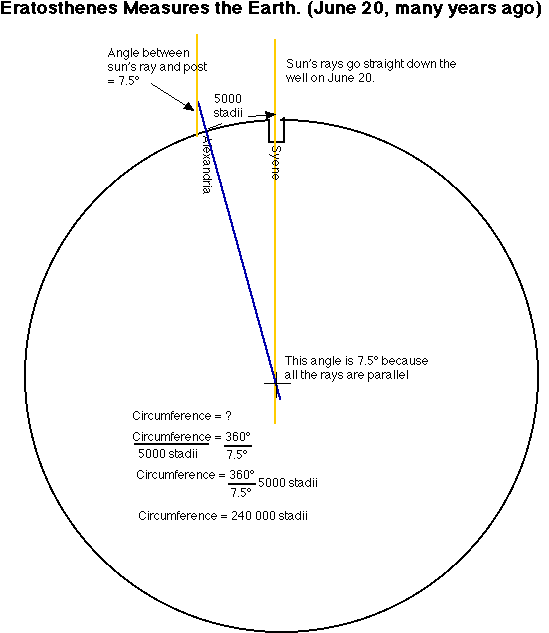
This is when I brought out the book The Librarian Who Measured the Earth by Kathryn Lasky again. We have read it some time ago (See my post on Erathosthenes). I started this series of Geometry session just so I can explain what we have read in this book. Now I could finally wrap everything up. My boys FINALLY understood how Erathosthenes measured the circumference of the Earth. (See my post on Geometry Session 1) Their reaction was a jaw-dropping, "Wow! Erathostenes was SO clever!"

Now back to D's Draw Squad drawing... Perpendicular and parallel lines are just all around us. We cannot escape these when we draw. We talked about these lines in real life (corners of walls, windows, boxes, tables etc.). We talked about what things really are and what we perceieve them to be. That is to say lines that are in fact parallel may not appear to be so because of perspective.

This is where I showed them the "magic" of the vanishing point in 3 dimensional drawing with a simple rough sketch of a street scene on our white board. B was excited when he saw this. He was inspired and drew his own street scene. Here it is...


With all this information, I then asked D to correct his first sketch of a house.

What a BIG detour we took?! Nonetheless a necessary one.

Saturday, November 1, 2008

Mathematics : Addition ++

Are your kids practicing their simple addition and subtraction sums and getting a wee bit tired of it? Here are two not so conventional looking sums that might make them sit up like they did to my two:

Try to solve for H, E and A if
HE
HE
HE
+HE
-----
HA
-----


or


What is C if
A
B
+C
----
AB
----

These are guaranteed encores! ... I am off hunting for more!

Wednesday, October 29, 2008

Copywork & Dictation : Pythagoras of Samos

As a follow-up to our study of Pythagoras, we read a chapter from the book Mathematicians Are People Too. Vol. 1 by Reiner and Reiner. This account focuses on Pythagoras as an adult and a teacher. We learned a little about the school he established. The practices of his "secret brotherhood" was a little disturbing. Nevertheless, I took the chance to discuss how the beliefs of different people can cause them to do strange things. It was eye-opening for my boys.

This is the paragraph I selected for copywork and dictation:

"All right. We'll start tomorrow. But remember, I need daily wages."

The next day the strange pair began their first lesson in the alley where they had met, amidst the cries of merchants and the mingled smells of fish, freshly baked honey cakes, and sweating donkeys carrying goods to sell. While the townspeople shopped and gossiped, Pythagoras and his student squatted in the dirt. The eager teacher drew shapes and figures on the ground. To Philocrates, it was all new but intriguing. And just as he promised, at the end of the day Pythagoras paid.

The following are words whose meanings the boys had to check:
proposition
wage
alley
amidst
mingle
gossip
intriguing

eager


Visit Rumphius English Webpage to find out more about how we approach English in our homeschool.

Tuesday, October 28, 2008

History / Geometry Session 3 : Pythagoras of Samos

Pythagoras of Samos is the next ancient Greek we are studying. He lived about 560 - 480 BC. He was a philosopher and mathematician. He is most famous for the Pythagoras theorem he discovered.

The picture book What's Your Angle, Pythagoras? by Ellis and Hornung made a good introduction to this great mathematician and his theorem. The boys were mesmerized by the story. As such their written narration (later posted on their own blogs! - See my post on Blogging) just flowed out of them quite spontaneously. I had initially assigned them to narrate just one part of the story, but they insisted on narrating almost the whole story!

Pythagoras was portrayed as a smart lad who helped the adults solve their problems. In reading the book, we gathered that in ancient times, builders use a rope with knots tied at regular intervals to find or check for right angles. The rope is a loop that can be pulled to make a triangle with 3,4 and 5 intervals on each respective side. We tried to make just such a rope. Here it is:


Pythagoras chanced on the theorem [(square of a) + (square of b) = (square of c)] when he was laying tiles around a right angle triangular base. We also tried to do the same here with our cuisenaire rods:


We were hoping to make more types of right triangles with our rods. I wrote the whole list of square numbers 1, 4, 9, 16, 25, 36, 49, 64, 81, 100, 121, 144. We stared at this list hoping to find two smaller square numbers that would add up to a bigger square numbers but couldn't. So we gave up.

The boys were introduced to square numbers in their Miquon Lab sheets. So this was not new to them.


My aim for this session was to introduce Pythagoras. I didn't expect my boys to be well-versed with the theorem. I was satisfied that they could understand that when we know the lengths of the two sides of a right triangle that make the right angle, we can calculate the length of the longest side (the hypotenuse). The specifics of actually calculating is beyond their level.

I am confident they'll recall what we have read about Pythagoras when we actually do have to master the theorem later. He will at least be a familiar "friend", not merely a dead and distant mathematician.


Visit Rumphius Mathematics Webpage or History Webpage to find out more about how we approach Mathematics or History in our homeschool.

Thursday, October 23, 2008

Mathematics : Geometry Session 2 - Triangles

This lesson is a continuation of my previous Geometry Session. (See my post on Geometry Session 1)

After a short review of the concepts covered in the previous session, I began with introducing different types of triangles, namely acute isosceles, obtuse isosceles, right-angle, equiangular/equilateral and scalene triangles.

Before this session, my boys have already had a chance to play around with a compass to draw circles. This time, I challenged them to construct an equilateral triangle with a fixed length. They tried hard but could only figure out how to construct an isosceles triangle. That was when I impressed them with how to construct an equilateral triangle using a compass and ruler.


They were excited and could not wait to try it out themselves! Thereafter, I gave them a large drawing paper and told them to construct many equilateral triangles. I needed these triangles for our next Art assignment ;-) Watch out for my post on that.

Friday, October 17, 2008

Mathematics : Geometry Session 1

I was reading the picture book, The Librarian Who Measured the Earth by Kathryn Lasky the other day (See my post on Eratosthenes) and came across some geometry concepts that the boys could not understand.


They could understand why the angle created in the middle of the Earth between the two cities was needed to find the circumference. They just couldn't comprehend how Eratosthenes measured that angle.

I have decided to attempt to give a brief introduction to basic geometry just so they could understand what clever Eratosthenes did to measure the circumference of the Earth without any modern technologyl!

I don't have any curriculum or teaching material to fall back on so I had to just cook something up. Here's what I tried to deliver in our first geometry session.
  • I told my boys to draw two intersecting lines.
  • Taught them how to use the protractor to measure angles. (eg. measure angle b)
  • Introduce the terms: acute, obtuse and right angles (I need them to know these because I would be reading a book about Pythagoras soon! He is another Greek mathematician.)
  • They already knew that 2 right angles make 180 degrees so it was not hard for them to see that two adjacent angles on a straight line make a total of 180 degrees. (eg. a + b = 180) I made them calculate adjacent angles (eg. angle c)
  • The amazing things was that when I asked them to measure the opposite angle (eg. angle d), D immediately said there is no need to measure because the opposite angles "are the same". My eyes nearly popped out. Wow! This was easier than I thought!
I was tempted to go on and on but appealed to my keener senses and decided that this was enough for a 7-year-old in one session! I left them to happily draw intersecting lines, measure angles and calculate angles while I slipped into the kitchen to prepare lunch. They were amused the WHOLE time!

Now, I will have to think of what I need to teach next...

Friday, October 10, 2008

Math / History : Prime Numbers & Eratosthenes

Our current Miquon labsheets are exploring the concepts of prime numbers and factors. The use of our cuisenaire rods had made it very easy for the boys to visualize these.

For enrichment, we read from an entertaining Math book called The Further Adventures of Penrose the Mathematical Cat by Theoni Pappas. There is a chapter in the book where Penrose the cat illustrated the concept of prime numbers and factors by arranging square tiles and explained how the name "composite numbers" was derived.

The chapter ends with a challenge to use 'The Sieve of Eratosthenes' to find the prime numbers from 1 to 100. This is my boys' untidy :-P but mathematically correct working:


In the process of crossing out the composite numbers to find the prime numbers (that are circled), we talked about even numbers, multiples of a number and number divisibility.

Since Eratosthenes happened to be a Greek mathematician who lived from 275 B.C. to 194 B.C. (the Greek era we are currently at for our History study), we decided to read more about him.

We read a beautifully written picture book, The Librarian Who Measured the Earth by Kathryn Lasky. The language used is very rich. The mathematical concepts discussed are a little beyond the boys now. (It covers a fair bit of geometry.) Nevertheless, my boys found the book engaging because it gives a very vivid description of ancient Greek culture.

They were thrilled to see the familiar Greek pottery in the illustrations. (We are half way making our Greek jars at the moment. Watch out for my post on that...)

Eratosthenes was described as being a child who loved and dared to ask questions.
B: Hey, isn't he just like Socrates?! (See my past post on Socrates)
Mama: Yes. :-)

We will surely be revisiting this book.


Visit Rumphius Mathematics Webpage or History Webpage to find out more about how we approach Mathematics or History in our homeschool.

Friday, September 19, 2008

Mathematics : Pre-Algebra


I tried boys out on some more "interesting" Math. They liked to solve these "puzzles" and even asked for more ;-)


Visit Rumphius Mathematics Webpage to find out more about how we approach Mathematics in our homeschool.
Related Posts Plugin for WordPress, Blogger...