site stats

Showing posts with label Unit Study. Show all posts

Sunday, June 21, 2009

Horse Unit Study (part 5) - Drawing Horses

For Art, we were broke away from our usual and galloped off on horses! Let me explain...

We were in the mood to draw horses since we have been reading so much about them. But horses aren't exactly the easiest animal to draw. So I pulled out some of my art books to see what I could put together. I read from How to Draw Animals by Jack Hamm. This book is published in the 1960s but yet the clarity of its instructions far surpasses that of more recent how-to books on the same subject.

What started out as a simple copying of horses unfolded into many successive sessions on animal drawing!

We started working from the beginning of the book where we learned about the shapes found in a generalized animal. We then learn how to put those basic shapes together when we look at an animal.

Here are some outlines we copied from the book. Notice the shoulder muscles, hip muscles and rib cage. These outlines are supposed to help in later shading and rendering of other surface details.

Shading of a generalized animal body was the emphasis for the next few sessions. It really gives the drawing depth and perspective.

Here's an attempt at applying the above concepts. I let my boys try outlining the animals from looking at photographs of animals. I wanted to see if they understood the concept. This is what they produced. Here is my boy's drawing of the basic outline of a donkey. He looked at a photograph in our Apologia Zoology 3 book.


The later part of Hamm's book focuses on different animal types and the usual challenges of drawing these animals. We jumped ahead to the section on Horses. (Couldn't wait!) We copied some of the horse drawings in that section.

Then each of us selected a picture of a horse from one of our other books to copy. Here are my boy's outlines. This was B's sketch from James Herriot's Treasury for Children.


This is D's mustang sketched from Album of Horses by Marguerite Henry.

Drawing and colouring are two separate skills. In the past, I noticed that my boys will be very discouraged when their colouring "ruined" their nicely drawn pictures. This time, I decided to make photocopies of their drawing for them to colour on. This is so that credit can be given to the drawing as well as the colouring; and each having something to show for. We used oil pastels. I joined in the fun too using my boys' drawings.


Drawing animals is indeed very challenging. A mistake in proportion can make a deer look like a dog, or a horse like a cow! For a long time, I myself have shied away from drawing animals. I am now glad I overcome my own phobia and gave it a try because I am pleasantly surprised at my boys' enthusiasm. I guess children just have a natural affinity for animals. I now wished I had done this little off tangent project sooner when we still had our zoo membership!

Monday, May 25, 2009

Horse Unit Study (part 4) - Horse Breeds

We are slowly soaking up all we can from our readings and making minibooks for our Horse lapbook as we are gathering new information.

We have been reading about various horse breeds in Album of Horses by Marguerite Henry. The history of the more common breeds are described in well-written prose. The language used is a little too sophisticated for my eight-year-olds. Even I am unfamiliar with many words that were used :-b But the information given is just too fascinating to miss. So I tried to get round the language problem by reading just a paragraph or two, then stop to discuss about what we can gather from that section. Many inferences had to be made and this skill has yet to be honed. Only after the discussion did I get my boys to narrate (just that section) while I type it out. It was a very slow process but I think it was good training.

Here is what we gathered about the Arabs:

Type of Horse: Riding Horse

Country of Origin : Arabian Desert

Size: 14.2 – 15h

Colour : The Arab horses can be any colour but must have black skin underneath so that it can protect them from the sun’s ray.

Interesting Facts:

Arabian horses can survive on very little food. If there isn’t grass to graze on, they can eat dead locusts, bruised dates and dry herbs. Arabs are used for war. The Arabian fighters ride only the mares and they call them “Daughters of the Wind”.

The owners will always make sure that the mares mate with the best Arabian stallions so that the colt will be the best. The owners will let the horses drink camel milk even before their own family drinks. This is how well they treated their horses. The colts are given camel as stepmothers to nurse on.

There are two famous people who rode on Arabian horses. George Washington rode on an Arabian horse called Magnolia and Napoleon rode on one called Marengo.

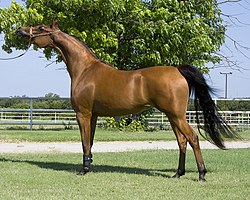
Arabian horses have arched necks and high flung tails. Their bodies are slender. They are the oldest domesticated horse species in the world.

More of these little write-ups will be added into out lapbook as we continue to read about the other breeds. Although my boys wanted to read about ALL the breeds, I insisted that we at least first cover the Thoroughbreds, Shire, Lipizzan, Mustang, Appaloosa, Quarter Horse and Shetland Pony.

Wednesday, May 6, 2009

Horse Unit Study (part 3) - Horse Poetry Book

We found an anthology of poems on Horses called A Classic Illustrated Treasury: Horses at the library.

There was even one poem by William Shakespeare!
Round hooft, short jointed, fetlocks shag, and long,
Broad breast, full eye, small head, and nostril wide,
High crest, short ears, straight legs, & passing strong,
Thin mane, thick tail, broad buttock, tender hide:
Look what a Horse should have, he did not lack,
Save a proud rider on so proud a back.
I was a little amused at how Shakespeare used pairs of adjective-nouns in this poem. That was somewhat similar to what we'd started out with when we first drafted our poem on the Centipede!

Another poem stood out from the rest.

My Pony
by "A."

How charming it would be to rear,
And have hind legs to balance on;
Of hay and oats within a year
To leisurely devour a ton;
To stoop my head and quench my drought
With water in a lovely pail;
To wear a snaffle in my mouth,
Fling back my ears, and slash my tail!

This poem gave me an idea for our next writing assignment! In my following post, I will share our poem on how wonderful it is to be a fish. :-)

Tuesday, May 5, 2009

Horse Unit Study (part 2) - Picture Book Study

We did a Five-in-a-Row styled book study of a picture book Mrs. Mack by Patricia Polacco.

I chanced upon this book while I was searching for free lapbook templates on horses. I got all my teaching ideas from this page in homeschool share. I used most of the suggestions there and we learned loads! (More lessons plans for other books in this site! A treasure trove! We used most of the lapbook templates from the links on this page. I will post more about that in a separate post.)

I think this story is not one that will appeal to all readers. The subject matter is a serious one but written from the heart. It is an autobiography of the author's first experience learning how to ride a horse and the special relationship she shared with a horse, her riding coach and her riding friends. We read this book with great interest because our first riding experience was still fresh in our minds. I remembered being told to "keep my hands soft" and "don't hang on to the saddle horn!"- familiar words Mrs. Mack reiterated.

Monday, April 6, 2009

Start of Horse Unit Study

My boys have developed an interest in horses and I thought I should take this opportunity to do a Horse Unit Study. We don't normally do Unit Studies but I think doing it once in a while, maximizing on current interests, can be a nice break from our usual routine.

I have just started the Unit Study with a chapter book The White Stallions of Lipizza by Marguerite Henry (a Sonlight selection). In the second chapter of the book, we learned about the names of the Lipizzaner ballet routine. Here they are :
(We found video clips of each to better understand the moves.)

1. piaffe
2. levade
3. coubette
4. capriole

The complete Lipizzaner routine.

Here is our narration/description of these different stunts in poem form:

The Lipizzaner Routines

The white stallions of Lipizza
Will always bring shouts of "Bravo!"
They are trained to perform piaffes,
Levades, courbettes and caprioles.

A piaffe is a move,
In which the horse will trot
And never go forward
But stay on the spot.

If you see a horse on two legs,
You are looking at a levade.
The show horse is still.
Horses do this in a parade.

See the horse rear up
And hop on its hind legs.
A horse doing a courbette
Is like a horse dancing a ballet.

A leap! A kick
Of the hind legs in the air.
With all four legs off the ground,
The capriole is an act that is rare.

The white stallions of Lipizza
Will always bring shouts of "Bravo!"
They are trained to perform piaffes,
Levades, courbettes and caprioles.


Credits:
Second stanza on piaffe by B.
Third stanza on levade by D.
Fifth stanza on capriole collaboration between B and I.

As I am typing this, my boys are having a ball of a time on all fours, pretending to be horses and attempting these four moves... and yes it's even more fun with a rider on the back shouting out commands!
Related Posts Plugin for WordPress, Blogger...