site stats

Showing posts with label History. Show all posts

Wednesday, October 28, 2009

History : Patricians and Plebeians

I have Charlotte Mason to thank for being able to integrate reading, comprehension, writing, spelling, vocabulary and grammar into history and social studies. I rolled all that in within an hour of read aloud, discussion and written narration!

Well, this is just what we do regularly. Unconventional?... I know. But it works for us.

We are in the middle of our study of ancient Rome, using The Story of the Romans by H. A. Guerber as our spine. We covered the period of the Roman Monarchy (750-500 BC) and are now into the period of the Roman Republic ( 500 BC-0). I interspersed our readings with commentaries from our Truthquest guide. These commentaries put us into perspective regarding how all these history go in line with biblical principles.

Here is my boys' narration of the two chapters we read today:

The Wrongs of the Poor

The poor plebeians were ill-treated by the rich patricians. When the plebeians had not enough money to pay their taxes, they had to borrow from the patricians. When the plebeians had not enough money to pay the patricians, the patricians were allowed to take their land and even sell them as slaves or put them in prison.

When the people from another city, the Volscians, attacked them, the plebeians were forced to go to battle. They didn’t want to fight for the patricians because the patricians were ill-treating them. The patricians promised the plebeians that when they come back from fighting, rules will be changed so that they will not be ill-treated anymore. When they came back, the patricians didn’t change any rules.

The Fable of the Stomach

Since the patricians didn’t keep their promise, the plebeians ran away to a mountain known as Sacred Mountain. Both the patricians and the plebeians suffered. The patricians had no farmers to till their land, no market men to buy food from and no merchants to buy articles from. The plebeians had only brought a bit of food with them, so they were starving. Yet the patricians couldn’t persuade them to come back. So they sent a wise man named Menenius to try convince them to come back.

Menenius observed that the plebeians didn’t understand the patricians’ long speeches. He decided to tell them a simple fable to show the plebeians what the situation is. The fable was about body parts. All the body parts didn’t want to work for the stomach, so the stomach ended up weak. The other parts of the body soon grew weak too. When the plebeians heard this story, they understood that they were the other parts of the body and the patricians were the stomach. So they all went back to Rome.

After that, new rules were made that pleased the plebeians. Officers were appointed to take care of the needs of the plebeians. They were called the Tribunes. The Tribunes can veto any law that is not fair to the plebeians. That means the Tribunes could disagree and stop the passing of any law that is ill-treating the plebeians.

Monday, June 15, 2009

History of China... Preliminary Plans

We visited the Asian Civilizations Museum three weekends ago to view the Kangxi Emperor Exhibition: Treasures from the Forbidden City. It was International Museum day and that meant the public could enter the museum for free!

My personal favourite object in the exhibition is a painting (on hand-scroll) that is 22 metres in length, depicting Kangxi emperor on his second inspection tour. We had fun studying the details of the painting and trying to spy where the emperor was. It's a pity we were not allowed to take pictures in the exhibition...

We spend some time musing at the not-so-ordinary family tree- what with 50 wives and 55 children!

Our interest in the History of China was sparked off and I am now researching to see how I can incorporate Chinese history into our History curriculum. That was my original plan anyway. I just haven't sat down to seriously do my research.

There is a spatter of Chinese history in Story of the World, but in my opinion, too superficial. Being Chinese, we ought to know more. It is a pity our command of the Chinese language isn't good enough for us to use Chinese history books (or any primary sources), we would have to resort to those in English instead.

Here are some things I've managed to find so far...

An Amazon Listmania provided me with a list of books I could use to explore deeper. Two books stood out from the rest; The Story of Ancient China (from Neolithic times through the Tang Dynasty) and its sequel China's Later Dynasties (mainly on China's last four dynasties - the Song, the Yuan, the Ming, and the Qing) both by Suzanne Strauss Art. They are written for middle school students (ages 10-14 yrs old) and look like wonderful spine books I could use for our study on the History of China!

Here are some websites with important information that is geared for children (I will add on to this list if I find more useful sites):

Post update on 12 July:
I found a unit study called Ancient China: To the Great Wall and Beyond by Judy Wilcox. This is a twelve-week study that brings you through eleven key dynasties through reading and project work. One interesting point brought up in reviews (1 & 2) was the fact that the student is challenged to research and make biblical contrast. Efforts were even made to relate historical events in China to the biblical timeline for context. This looks really promising!

Post update on 14 July:
Here are 2 books available as etext on Chinese History:
1. China's History by William E. Griffis
2. The Story of China by R. Van Bergen

Sunday, March 29, 2009

Medieval Birthday Celebration

Preparation for the Medieval Party started about two weeks before the event. Invitation cards were sent out and details were planned. Actual gathering of material and making of things took place a week before. It was a nice departure from our usual school routine. This happened to coincide with the one week school holidays so we had "lighter" school days then.


Costume

We wanted a costume party but did not expect our guests to come with the appropriate costumes. In any case, we don't have costumes either. We figured we could make very simple ones. This is what I did. I used gray coloured cotton fabric, cut them into rectangular sheets and use a safety pin to pin the back and front flaps at the shoulders. I had initially wanted to sew / hem these but time did not permit that. I was glad the fabric we chose lasted one wear with rather minimal fraying.

D and B designed their own coat of arms. We read the book Coat of Arms by Catherine Daly-Weir. This book comes with templates so that made it easier. The symbols and animal designs were drawn or traced onto coloured papers and then cut out. These cut-outs were then glued with white glue on a shield shaped flannel. The completed crest was in turned glued onto the gray armour. (I am beginning to discover how useful white glue is!) This method required no sewing at all!!! What a time saver?!

Coat of Arms gives detailed explanation on the significance of the colours and symbols that are often used. These are my boys' final products. They each made crests for all the members in their group for the Dragon Hunt.


Welcome Table / Decoration

I found idea of giving fictitious names to our little guests from this site. We came out with ridiculous sounding names that are food related (Straw of Berry, Gin of Ger, Guard of Lick, Man of Gostin etc...) These names were written on ice-cream sticks that were decorated to look like mini swords. The idea was to let our guest draw a "sword" out from the "rock" like King Aurthur style. The illuminated letters we made were put to good use in a little poem I composed to explain what to do.


Music

What is a party without music?! I hunted long for these and asked at forums to finally find a site that allows for download of MP3s! Gregorian Chants and other such church music (which are what most people know of music of that period) were much to solemn so I chose Medieval Dances instead. Here is a site of Medieval Dances. I selected the album from Anstrorran Dance Symposium for our "banquet".


Craft 1 - Glorious Goblets

I wanted to occupy the children while they waited for the food to be ready. I got the idea of decorating plastic wine goblets with sequins from this site. These are some that were decorated by the children.


These goblets were then used during the party for drinks. No problem with mixed-up cups ;-)


Archery

We have two wooden bows we bought long ago at Daiso. D and B love to play with these; shooting chopsticks along our corridor. We experimented and found that these bows could actually be used to shoot chopsticks into cardboard boxes!


D and B were excited to let their friends try their hands on some archery too. However, we were worried the bows might give way if they were pulled too hard so we decided to add a toilet roll core on our target board as the bull's eye instead. Accurate shots, regardless of the power of the shot, would lodge the arrow into the tube; the arrow should sit comfortably in the tube even if it doesn't pierce the cardboard. This set up worked pretty well :-) I think the children enjoyed this quite a bit.


Craft 2 - Medieval Arrows


Chopsticks as arrows don't look very pretty. We decided to dress our arrows up! I found how to make a medieval arrow from this video clip. I simplify the steps a little and tried to teach this to the kids. This craft required some fine motor skills so mothers were roped in to help. This project didn't turn out too well but I hope some interest was generated :-b

Dragon Hunt


I sent the children on a wild-goose-chase kind of Dragon Hunt. Each clue was written in a poem that played around with words. I composed these poems one day while my boys stayed over at their grandparent's place. I enjoyed myself thoroughly and in the process renewed my interest in poetry! The children had to decipher the clues. There was just a lot of scrambling around from place to place - all around my estate. :-D

I originally intended them to find the dragon and throw tennis balls into the eye of the dragon. But because we were running late, the final Dragon thrashing was skipped. :-(


Food

We had medieval potash with bread. Traditionally, potash was marshy soup with potatoes, beans and various spices. I concocted one without the more unfamiliar stuff. I decided to have pizza as a supplement just in case people are not used to medieval food.

It has become a "tradition" for me to bake apple pies instead of birthday cakes for my boys. (They are two of those weird kids who dislike cakes.) So I did bake two apple pies. Unfortunately, I didn't time myself properly so the baking time extended into the time for preparation of the other party food. As a result, my poor guests had to wait patiently for their lunch.

My dear husband was such a great help in the kitchen that day with assembling the pizzas while I got the children organized and prepared the other stuff. In our original plan, he was supposed to be the jester - juggling and entertaining... haha. Well, thankfully we don't have grumpy guests to cheer up and the children were left to entertain themselves most of the time.


All in all...

We all had fun!! Fun during the preparation as well as during the party itself. I am just super exhausted after that! I truly think it was well worth it though.

I kind of like this sort of themed party. May consider doing a Greek /Roman themed party next time... but without the food. Haha... Cooking is really not my forte :-)

Sunday, March 22, 2009

Getting into the Medieval Mood

This pass week was a mad week for us. We were in the thick of preparing for my boys' 8th birthday celebration.

Knights and castles. Swords and armour. Bows and arrows. Horses and dragons. My boys just LOVE everything about the middle ages.

So when I agreed to have their first ever birthday party, I decided we'll have a medieval themed one. (I have always heard about or read about people having themed parties but have never had or attended one! And they sounded so fun. I just have to try one!). I was at first a bit hung up about not timing it with our History studies. Should I do it next year instead? That's the perfectionist in me speaking. But I decided to be spontaneous about it. I just want to let my boys have fun!!!

We have shied away from having any parties previously because I wasn't sure I could handle the logistics of one. How to feed so many people? What to do with the children? Oh no! Have to plan games? How to entertain everybody?! ... So much work!!!

Then recently, I read about the wonderful birthday party a good friend of mine planned for her son. I was amazed at her dedication and creativity! I was really put to shame. Haha... in a good sense because I was all inspired after that. She spoke about making memories for her children and that set me thinking... It is just this few years really, may be between the ages of 6 to 12. I don't think a teenager would fancy one at all. It would be too "childish" for them then.

So here I am, going to give it a try ... starting really small with inviting only 3 families. Just don't think I could cope with more... :-b (Have already exceeded the rule of "number of friends to invite equals age of child" rule.)

I hope to do a crash course on History in the Middle Ages (just for this two weeks) ... just a bit of this and that. This would serve as an introduction for later studies. I just couldn't resist it. :-b

In order to get the boys into the mood (Like they needed help!?), I chose a book that is set in the middle ages for our read aloud. It is King of Ireland's Son by Padraic Colum. Reviews of the book revealed that some clever story-telling is exhibited in the weaving of stories within a story. I have been saving this book for when we are "there" for History, but have decided now is good enough! This book has been a page-turner so far. More a fun and fantasy type book rather than one that gives detailed introduction to that period in history. Nevertheless an enjoyable read.

These were the books I assigned for independent reading this week:
Saint George and the Dragon by Margaret Hodges
The Kitchen Knight by Margaret Hodges
A Medieval Feast by Aliki
If You Live in the Days of the Knights by Ann McGoverit

There are many more of such books. I just chose those I could get my hands on.

Tuesday, March 3, 2009

Hippocrates and the Caduceus

At the moment, I am using Story of the World (SOTW) vol. 1 as my core text book for history. I also have in mind to cover some well-known people as listed and recommended in The Well-Trained Mind by Susan Buer Wise and Jessie Wise. So whenever those people are not mentioned in SOTW, I would have to research and find material to work on myself.

I found a new History curriculum called Mystery of History (MOH) by Linda Lacour Hobar. The first volume in this series is titled Creation to the Resurrection. I was attracted to this curriculum because it attempts to weave Bible History into World History. The sample pages showed a wide coverage. I know because I saw that MOH included many of the extras that I added into my History curriculum. I was thrilled so I went ahead to get MOH.

This is where I am now. Having already started on SOTW, with the boys enjoying it. Yet attracted to another curriculum that is sequenced quite differently. I am torn between the two!!

I haven't yet decided what to do. My plan for now is to continue with SOTW as my core and use only those lessons from MOH as and when I need them. This will give me some time to try MOH out and hopefully I will get a better idea of what I should do next.


The next Great Men of Greece that is on my list was Hippocrates. We learned about his contribution to society by first drafting out the Hippocratic oath that is now still taken by every practicing physician. I read the relevant lesson from MOH and let my boys narrate the passage. They begged to make the Caduceus, another craft project they saw in Spend the Day in Ancient Greece by Linda Honan. I was not too keen initially, but have not the heart to object especially since they were so eager. Because this was quite unplanned, I did not have much information about the Caduceus to share with my boys. My boys are now getting the hang of searching for information from the Internet, so that is what we did!


Visit Rumphius History Webpage to find out more about how we approach History in our homeschool.

Tuesday, February 10, 2009

Aristophanes and Greek Writing


One of the the great Greek figures we read about as part of our History studies was Aristophanes. A little paragraph in the book The Librarian Who Measured the Earth by Kathryn Lasky has a short paragraph that tells of his contribution to mankind. He was apparently the one who introduced spaces between words. What a clever guy!

I wished Chinese sentences also have spaces in between words. I often have to pre-read Chinese story books not just to make sure I know how to read the words, but also to draw brackets around names and terms. It gets very confusing reading especially when the names are translated from another language and each name can be 3 or 4 or 5 characters long! I really don't know, at first glance, where the name starts and where the name ends. Or maybe I am the only person who have this difficulty!!

A book that I found in the library called Spend the Day in Ancient Greece by Linda Honan has very interesting projects. I like the short informative write-ups before each project. We have attempted quite a number of the projects from this book. This time, we decided to try some calligraphy in Greek! First, my boys had to figure out some Greek names. They were thrilled to see the characters in The Illiad appearing here in Greek. They then wrote their own names in Greek. With the phonetic chart provided, they formed English words using Greek letters. You can take a look at the their end products in D's and B's blogs respectively.


Visit Rumphius History Webpage to find out more about how we approach History in our homeschool.

Friday, December 12, 2008

History : Mapping Out Alexander's Invasions

My boys were intrigued with Alexander and his invasions and conquests. We have decided to map out the main points of his conquest. The book You Wouldn't Want To Be In Alexander the Great's Army! by Antram and Morley was the book that first sparked this idea off.

We found the etext of The Story of Greece by Mary Macgregor in the Baldwin Project website. This book has a few chapters regarding Alexander the Great. This together with a few other library books were the main source of our latest project.

We presented everything in a 3-fold lapbook. The boys sieved through all the books and webpages to pick out key points at each location of Alexanders journey. They typed these down in a Word document. They also googled to find pictures to correspond with their write-ups. Grandad helped with printing them on his colour printer. I helped with the layout.

Here is what we have gathered and put together.


These are the events we zoomed in on:
1. The Battle of Granicus
2. The Battle of Issus
3. The Battle of Tyre
4. The Conquest of Egypt
5. The Battle of Gaugamela
6. The Battle of Persepolis
7. The Battle at Hydraspes River
8. The Death of Alexander in Babylon

Can you tell how crazy my boys are about Alexander? :-)


Visit Rumphius History Webpage to find out more about how we approach History in our homeschool.

Saturday, December 6, 2008

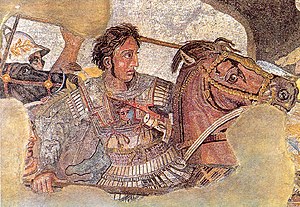
History : Alexander the Great


Our history readings brought us to the times of Alexander the Great. Story of the World vol 1 (SOTW) describes briefly some important facts about this great man. It was a little of an anti-climax because my boys, having read on their own a few books about Alexander, knows more about him than was covered in SOTW! As such, their narrations were "adulterated" with information from those other books. However, I welcomed those "extra" information.

I am reminded and assured that my children's learning don't always depend on my teaching them. They are perfectly capable of discovering and learning themselves. Don't we parents worry too much about that sometimes!!

As we were searching for images to accompany their narration, we came across an interesting etext of James Balwin's Thirty More Famous Stories Retold. Baldwin is no stranger to me as I already have his other book Fifty Famous Stories Retold. I was thus pleasantly surprise to find this. Baldwin's version of the Gordian Knot was different somewhat from what we read in SOTW.

Below is my boys' narration of the Gordian Knot as told in SOTW. Read the two versions yourself and see the difference.


When his father died, Alexander took over his throne. He went across the Aegean Sea toward the Persian Empire. He found a chariot tied up with a knot that was bigger than a man’s head. No one could untie this enormous knot. He was curious so he asked a stranger about it. The stranger told him that there is a legend that says that whoever can loosen this Gordian knot can take the chariot and will rule the whole of Asia.

Alexander used his sword to cut the knot into half and loosened it. Nobody thought of this method before.

Alexander eventually became king of the Persian Empire. He marched his army down to Egypt and was crowned Pharaoh. He also conquered Mesopotamia.

Alexander’s empire was the biggest empire that the world had ever seen. He was known as
Alexander the Great!"


It brings to light some important points. History is NOT an exact Science. History is written by people. Different people see and interpret events differently. People may also embellish their writings with interesting details that may not be accurate.

This gives me a chance to point out to my boys that as a reader, we must not always believe what we read (or hear or see...). We should always refer to different sources, so that we can see the bigger picture, and also be in a better position to evaluate a piece of information.


Visit Rumphius History Webpage to find out more about how we approach History in our homeschool.

Wednesday, November 19, 2008

History / Mathematics : Parthenon and the Golden Rectangle

We first read about the Parthenon in our Histroy core book Story of the World vol. 1 by Susan Wise Bauer. Subsequently, we learnt more about this ancient ruins from the travels of Richard Halliburton in his Complete Book of Marvels. Two paragraphs were used for copywork and dictation. (See my post on Parthenon for copywork)

We started making a model of the Parthenon when we first read about it. It took us several session of cutting and pasting to complete the model. It actually took us almost 10 hours to complete it! With 14 internal and 46 external columns to roll and glue, I don't think the boys (and I) will ever forget the Parthenon!

Here is D cutting away... look at the tray of columns ready for gluing.


Here is B with the half completed temple beside him...


We had to weigh the columns down with books while we let the glue set.


Here is the completed model. Impressive? (I'll have to arm-twist you to say YES in any case!! :-o)


This project is about the most labour intensive one we have ever embarked on. Of course we didn't know it will be like this when we started. I kept spirits high throughout by setting small achievable goals at each session. So some sessions were not more than an hour long. We enjoyed ourselves in the process. I am just not sure we will try something similar again though ;-)

In a related reading from Penrose the Mathematical Cat by Theoni Pappas, we learned about the golden rectangle and its fascinating characteristics. The golden ratio was mentioned but what was more obvious to my two boys was the ability to draw in infinite number of squares within the golden rectangle.

We were intrigued that the golden rectangle can be seen in many natural things around us like the butterfly or dragonfly. And if you draw aches within the squares, you get equiangular spirals that were supposed to be similar to that found in some snails.

Many a man-made objects also have the golden rectangle eg. credit cards and the Parthenon! Apparently, artist and architects incorporate the Golden Rectangle in their art works. You can read more about the obsession with the Golden Ratio at this site.

My original plan was to just read through the chapter on the Golden Rectangle, but just when we finished my boys enthusiastically asked if we could construct a Golden Rectangle (Penrose showed us how to do it - This site has a similar approach). Before I even had time to answer, they were off the sofa running to fetch paper and pencil.

We did try to construct Golden Rectangles. Then it daunted on us that we need to know a way to check if a rectangle was "golden". We managed to figure that out after some thinking. So we tried to check if my credit cards were Golden Rectangles. To our disappointment, it was not! Oh well... it just goes to show we mustn't always believe what we read. Ha ha... It was enlightening nonetheless.


Visit Rumphius Mathematics Webpage or History Webpage to find out more about how we approach Mathematics or History in our homeschool.

Sunday, November 9, 2008

Homer's The Iliad

We have read about Homer and his two famous works The Iliad and The Odyssey. I had planned to read a retelling of these two stories. We own the book Children's Homer by Padraic Colum so it just seemed natural to start with that. However, I was disappointed that my boys couldn't quite understand it as it was pitched at a higher reading level. I decided to put the book aside for now and try another. I checked my classical book lists and selected another retelling called Black Ships Before Troy by Rosemary Sutcliff.

I was glad to see several copied of this book in the library. This is helpful because we usually read a chapter or two a week and will normally take longer than 3 weeks (that's the library loan period) to complete the book. In this case, we can borrow the other copies when our first loan period expires.

Black Ships Before Troy is our current "on-the-go" book. That means I bring it wherever we go and read to my boys whenever we have time. This normally happens during our commute in trains or when we are early for classes and have some time to kill (I hate to say that especially when I always feel I am so short on time!).

We are enjoying it thoroughly. My boys are always begging for more. In fact, I like it so much I might consider reading The Wanderings of Odysseus by the same author at a later date. This is a re-telling of The Odyssey by Homer.

I am not sure if this is an overkill since my boys have just started reading a series about The Odyssey by their favourite author Mary Pope Osborne (author of the Magic Tree House Series). We'll see...


Visit Rumphius English Webpage and History Webpage to find out more about how we approach English and History in our homeschool.

Saturday, November 8, 2008

Kings of the Divided Kingdom

We are reading through The Child's Story Bible by Catherine Vos. Our read aloud chapter today was Chapters 88. We are getting a bit overwhelmed and confused with the many kings that we are reading about. (P is the son of ??? and Q is the king of ??? and R is the king of ??? who killed S the king of ??? and is S a bad or good king? and is Q the one who reigned for only one year? ... ARHHH!) I should have charted them somehow when we started reading about them.

Well, better late than never. This week, I decided to do something about it. I set an assignment for the boys. They were to read a chapter at a time from chapter 78 (that is at the point of Solomon's death). Their task was to make an index card for each king, indicating whether they were king of Judah or Israel and whether they were good or bad kings. They were also to include any interesting facts about that king that can help jog our memories.

We decided on a colour code for the cards so that some information can be obtained at a glance:
Green left margin for King of Judah
Blue margin for Kings of Israel
Red right margin for bad kings
Blue right margin for good kings.

B's entry for King Asa went like this:

Green left margin = King of Judah
King Asa

- He destroyed all the idols he could find.
- He prayed to God when enemies came.

Blue right margin = Good King


This is what B came up with so far... more to come. (Sorry for the blur picture. Just to give you a rough idea of what I am talking about.)


I hope that this will help them remember the stories better. The cards can also be used for reviews and to arrange in chronological order if we ever get that proficient(!).

MY "homework" would then be to make timeline cards for each of these kings (or at least the more well-known ones ;-)) for our wall timeline.

Do you have any suggestions as to how to better tackle the historical aspect of this part of the Bible? I will be glad to hear them :-)


Visit Rumphius Bible Webpage and History Webpage to learn more about how we approach Bible and History in our homeschool.

Wednesday, October 29, 2008

Copywork & Dictation : Pythagoras of Samos

As a follow-up to our study of Pythagoras, we read a chapter from the book Mathematicians Are People Too. Vol. 1 by Reiner and Reiner. This account focuses on Pythagoras as an adult and a teacher. We learned a little about the school he established. The practices of his "secret brotherhood" was a little disturbing. Nevertheless, I took the chance to discuss how the beliefs of different people can cause them to do strange things. It was eye-opening for my boys.

This is the paragraph I selected for copywork and dictation:

"All right. We'll start tomorrow. But remember, I need daily wages."

The next day the strange pair began their first lesson in the alley where they had met, amidst the cries of merchants and the mingled smells of fish, freshly baked honey cakes, and sweating donkeys carrying goods to sell. While the townspeople shopped and gossiped, Pythagoras and his student squatted in the dirt. The eager teacher drew shapes and figures on the ground. To Philocrates, it was all new but intriguing. And just as he promised, at the end of the day Pythagoras paid.

The following are words whose meanings the boys had to check:
proposition
wage
alley
amidst
mingle
gossip
intriguing

eager


Visit Rumphius English Webpage to find out more about how we approach English in our homeschool.

Tuesday, October 28, 2008

History / Geometry Session 3 : Pythagoras of Samos

Pythagoras of Samos is the next ancient Greek we are studying. He lived about 560 - 480 BC. He was a philosopher and mathematician. He is most famous for the Pythagoras theorem he discovered.

The picture book What's Your Angle, Pythagoras? by Ellis and Hornung made a good introduction to this great mathematician and his theorem. The boys were mesmerized by the story. As such their written narration (later posted on their own blogs! - See my post on Blogging) just flowed out of them quite spontaneously. I had initially assigned them to narrate just one part of the story, but they insisted on narrating almost the whole story!

Pythagoras was portrayed as a smart lad who helped the adults solve their problems. In reading the book, we gathered that in ancient times, builders use a rope with knots tied at regular intervals to find or check for right angles. The rope is a loop that can be pulled to make a triangle with 3,4 and 5 intervals on each respective side. We tried to make just such a rope. Here it is:


Pythagoras chanced on the theorem [(square of a) + (square of b) = (square of c)] when he was laying tiles around a right angle triangular base. We also tried to do the same here with our cuisenaire rods:


We were hoping to make more types of right triangles with our rods. I wrote the whole list of square numbers 1, 4, 9, 16, 25, 36, 49, 64, 81, 100, 121, 144. We stared at this list hoping to find two smaller square numbers that would add up to a bigger square numbers but couldn't. So we gave up.

The boys were introduced to square numbers in their Miquon Lab sheets. So this was not new to them.


My aim for this session was to introduce Pythagoras. I didn't expect my boys to be well-versed with the theorem. I was satisfied that they could understand that when we know the lengths of the two sides of a right triangle that make the right angle, we can calculate the length of the longest side (the hypotenuse). The specifics of actually calculating is beyond their level.

I am confident they'll recall what we have read about Pythagoras when we actually do have to master the theorem later. He will at least be a familiar "friend", not merely a dead and distant mathematician.


Visit Rumphius Mathematics Webpage or History Webpage to find out more about how we approach Mathematics or History in our homeschool.

Wednesday, October 22, 2008

English / History - Copywork & Dictation : Parthenon, Temple of Athena

From Complete Book of Marvels by Richard Halliburton...

A feeling of awe comes over us... we are standing before something more than just a famous ruin - it is the ruin of the finest monument of the world's Golden Age, when men worshiped beauty. We know we tread on sacred ground. The greatest geniuses of ancient Greece have moved across this same pavement - sculptors, artists, teachers, writers, warriors.

We wander down the tall row of columns. How worn they are by twenty-three centuries of wind and rain, how scarred by battle! But now in the late afternoon sun they glow with life. We look out between the columns towards the shining Aegean Sea, and find that the very light has turned a lilac colour which bathes every stone about us with the same lovely shade.


Visit Rumphius English Webpage to find out more about how we approach English in our homeschool.

Wednesday, October 15, 2008

History : Greek Jars

We read that a Greek amphora was a two-handled jar with a flared neck, usually made big enough to hold about 10 gallons of olive oil. To win one was such an honour that some athletes were buried with the amphoras they had won! We were thus inspired to make our very own miniature Greek amphora.

However, we were faced with some challenges.

We used a air-drying red clay to make our replicas. This clay was leftover from our Sumeriam cuineform tablets project some months ago. They have hardened significantly and have become extremely crumbly. So we could not shape our jars to have the flared necks as planned. Instead, we used a disposable plastic cup to stick our patchy clay onto it just to get the shape right. (I read about this method from a project book but didn't like the idea at first. But it looked like that was the only way to go with this sort of clay.)

We had to change the whole design of the jar after that. No handles were added because our clay was just impossible to shape. After an hour of shaping, we did end up with something that looked like a jar. These were left to dry before we removed the plastic cup inside and continued with some more patching.

Unfortunately, at this point, B's jar rolled off the table and cracked. It was too badly damaged that it was now impossible to repair. I had to be quick to think of a way to console him. I assured him that it was alright because we could pretend that the broken pieces were excavated from a Greek acheological site. It would be fun to piece our "ancient artifacts" together again; just like what real archeologists do.

He liked the idea a lot and was wholehearted in completing his decorations!

We searched for authentic Greek designs. Many of the pictures of Greek jars showed drawings of athletes in action or pictures from Greek mythology. These I thought would be too difficult to reproduce, so we decided to try the simple geometric designs that were typical of the jars in the Dark Ages of Greek history.

So here are the end products - our ancient Greek treasures; one a "rare" complete piece and the other, pieced up together from broken relics ;-)


This just goes to show that not all our little projects go smoothly as planned. Hiccups here and there sometimes force us to change our plans completely. Isn't life like this all the time?! Being flexible makes life so much easier to bear...

B is now enjoying taking his broken jar apart to reassemble. :-) And they look forward to really making an amphora. (er... if we have the time?!...)


Visit Rumphius History Webpage to find out more about how we approach History in our homeschool.

Friday, October 10, 2008

Math / History : Prime Numbers & Eratosthenes

Our current Miquon labsheets are exploring the concepts of prime numbers and factors. The use of our cuisenaire rods had made it very easy for the boys to visualize these.

For enrichment, we read from an entertaining Math book called The Further Adventures of Penrose the Mathematical Cat by Theoni Pappas. There is a chapter in the book where Penrose the cat illustrated the concept of prime numbers and factors by arranging square tiles and explained how the name "composite numbers" was derived.

The chapter ends with a challenge to use 'The Sieve of Eratosthenes' to find the prime numbers from 1 to 100. This is my boys' untidy :-P but mathematically correct working:


In the process of crossing out the composite numbers to find the prime numbers (that are circled), we talked about even numbers, multiples of a number and number divisibility.

Since Eratosthenes happened to be a Greek mathematician who lived from 275 B.C. to 194 B.C. (the Greek era we are currently at for our History study), we decided to read more about him.

We read a beautifully written picture book, The Librarian Who Measured the Earth by Kathryn Lasky. The language used is very rich. The mathematical concepts discussed are a little beyond the boys now. (It covers a fair bit of geometry.) Nevertheless, my boys found the book engaging because it gives a very vivid description of ancient Greek culture.

They were thrilled to see the familiar Greek pottery in the illustrations. (We are half way making our Greek jars at the moment. Watch out for my post on that...)

Eratosthenes was described as being a child who loved and dared to ask questions.
B: Hey, isn't he just like Socrates?! (See my past post on Socrates)
Mama: Yes. :-)

We will surely be revisiting this book.


Visit Rumphius Mathematics Webpage or History Webpage to find out more about how we approach Mathematics or History in our homeschool.

Wednesday, October 8, 2008

English - Copywork & Dictation : Battle of Marathon

From Story of the World Vol. 1 by Susan Wise Bauer...

When the Persian army landed, they launched thousands of arrows at the Athenian army. But the men of Athens charged through the arrows and attacked the Persians. The Persians were so startled and disorganized that they lost the battle! They were forced to retreat.

When the Athenians saw that they had won the battle, they sent a runner back to Athens, to tell the people who were anxiously waiting at home that the Persian threat had been driven back. The runner, Pheidippides, ran over twenty-six miles, up steep hills and through rough country, to reach Athens. When he arrived at the city, he gasped out, "We have won!" And then - according to legend - he died of exhaustion.


Visit Rumphius English Webpage to find out more about how we approach English in our homeschool.

Tuesday, October 7, 2008

History : Greek Paper Dolls

When I was planning our History lesson on Greek Wars, I didn't think much of the making of paper dolls activity suggested in the Story of the World Activity book. I made photocopies of the doll anyway, ... just in case.

Lo and behold, they were snatched and worked on even before the paper had a chance to cool off after rolling out of my printer! What's more, I haven't even read aloud the chapter on Greek Wars! Haha... That is the problem I face; I do not have the privacy that school teachers have to prepare lessons.

My boys conscientiously cut, coloured and assemble the dolls while I was busy preparing dinner.

They were more interested in the warriors obviously. I had to persuade them to complete the lady dolls as well. They did those quite unwillingly at first but found them useful afterwards when they were role-playing because at least now Odysseus and Hector has a Helen to fight over ;-)


They took quite a lot of pains in choosing names for their dolls; reread some portions of their history books and other story books with Greek themes to find the bravest Greek warrior. It was quite hilarious initially because they insisted on calling one Robin Hood. To that, my respond was, "No, no. Wrong era!"

I managed to sneak in some Mathematics as they were constructing their dolls. They needed to prop the dolls up with triangular bases. I had a chance to introduce such terms as right-angle triangles, isosceles triangles and equilateral triangles.

That night, they made me promise to read the chapter on Greek Wars the next day.

All in all, this turned out to be a rather fruitful session.


Visit Rumphius History Webpage to learn more about how we approach History in our homeschool.

Thursday, September 25, 2008

History : Socrates

Today we read about the famous Greek philosopher Socrates in a children's picture book Wise Guy: The Life and Philosophy of Socrates by M.D. Usher.

We learnt that Socrates was one who loved to question about things. He was not proud but admitted openly that he knows nothing. And THAT was the beginning of his quest for knowledge and wisdom. It was a precious lesson on humility.


We made a little accordian file with pages in it that tells the story of Socrates. The boys had to read and decide for themselves what they wanted to write. I gave them 4 key questions as a guide. They are:
1. Who was Socrates?
2. What was Socrates like as a child?
3. What are some of Socrates famous sayings?
4. What happened to him in the end?

We googled and found lots of his quotes. Some of them were a little too profound for my boys to appreciate but they got the general idea for most of them. Here are some of our favourites:

* He is a man of courage who does not run away, but remains at his post and fights against the enemy.
* He is richest who is content with the least, for content is the wealth of nature.
* It is not living that matters, but living rightly.
* Let him that would move the world first move himself.
* Wisdom begins in wonder.
* Worthless people live only to eat and drink; people of worth eat and drink only to live.
* True knowledge exists in knowing that you know nothing.


Visit Rumphius History Webpage to learn more about how we approach History in our homeschool.

Thursday, September 18, 2008

History : Dig Up Ancient Greece! Board Game


I have just finished making a board game that I downloaded from the internet called "Dig Up Ancient Greece!"

This game dovetails perfectly with what we are doing for History now! Quiz cards test boys on the knowledge of ancient Greece. They were thrilled to be able to answer questions about the Minoans and Homer and such trivia. What's more, they will soon be familiar with the geography of that region. That will be invaluable knowledge as many of the cities there are mentioned in the Bible.

Anyway, who can resist the fun of collecting ancient treasures!


Visit Rumphius History Webpage to learn more about how we appraoch History in our homeschool.
Related Posts Plugin for WordPress, Blogger...