site stats

Monday, May 25, 2009

Horse Unit Study (part 4) - Horse Breeds

We are slowly soaking up all we can from our readings and making minibooks for our Horse lapbook as we are gathering new information.

We have been reading about various horse breeds in Album of Horses by Marguerite Henry. The history of the more common breeds are described in well-written prose. The language used is a little too sophisticated for my eight-year-olds. Even I am unfamiliar with many words that were used :-b But the information given is just too fascinating to miss. So I tried to get round the language problem by reading just a paragraph or two, then stop to discuss about what we can gather from that section. Many inferences had to be made and this skill has yet to be honed. Only after the discussion did I get my boys to narrate (just that section) while I type it out. It was a very slow process but I think it was good training.

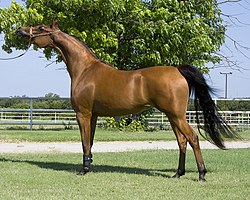
Here is what we gathered about the Arabs:

Type of Horse: Riding Horse

Country of Origin : Arabian Desert

Size: 14.2 – 15h

Colour : The Arab horses can be any colour but must have black skin underneath so that it can protect them from the sun’s ray.

Interesting Facts:

Arabian horses can survive on very little food. If there isn’t grass to graze on, they can eat dead locusts, bruised dates and dry herbs. Arabs are used for war. The Arabian fighters ride only the mares and they call them “Daughters of the Wind”.

The owners will always make sure that the mares mate with the best Arabian stallions so that the colt will be the best. The owners will let the horses drink camel milk even before their own family drinks. This is how well they treated their horses. The colts are given camel as stepmothers to nurse on.

There are two famous people who rode on Arabian horses. George Washington rode on an Arabian horse called Magnolia and Napoleon rode on one called Marengo.

Arabian horses have arched necks and high flung tails. Their bodies are slender. They are the oldest domesticated horse species in the world.
More of these little write-ups will be added into out lapbook as we continue to read about the other breeds. Although my boys wanted to read about ALL the breeds, I insisted that we at least first cover the Thoroughbreds, Shire, Lipizzan, Mustang, Appaloosa, Quarter Horse and Shetland Pony.

Saturday, May 23, 2009

More Good Books to Read Aloud for Art

A friend of mine (Thanks F!) shared a wonderful etext that will be a great resource for our future artist study - Knights of Art: Stories of Great Italian Painters by Amy Steedman.

I have known quite long ago of an art book by V. M. Hillyer. (He is the fantastic author of Child's History of the World and Child's Geography of the World!) I was intending to buy it secondhand. But because it is so good, the price is still high even when the books are old. I recently found a site that gives the etext of his book, A Child's History of Art.

I am now DANCING A JIG!!!

PS: If you have other good Art related books to recommend, please do leave a note here using the "comments" function. Thanks!

Tuesday, May 12, 2009

Art : Jan van Eyck : Read Aloud

We are currently reading through Looking at Pictures: An Introduction to Art for Young People by Joy Richardson . My plan is let the chapter on "Hidden Meanings" coincide with our picture study of Jan van Eyck's painting "The Arnolfini Portrait".

This particular painting is also featured in Art Fraud Detective by Anna Nilsen. This book will be next in line in my boys' assigned reading list to heighten interest. Readers are supposed to pretend to be detectives to find out who painted the fakes in a gallery of paintings and hopefully learn a thing or two. Looks like fun to me!


Visit Rumphius Webpage Art to find out about how we approach Art in our homeschool.

Wednesday, May 6, 2009

I Wish I Were a Fish (a poem)

We read a few poems with this form: AAB, CCB ... and liked it. A well-known one is the poem At the Seaside by Robert Louis Stevenson. We composed a poem using this form; drawing inspiration from the guppies in our aquarium.

I Wish I Were a Fish
How wonderful it is to be a fish
To always be free to swim and swish
My delicate rainbow tail.
I can sleep whenever I'm tired
And have lots of peace and quiet
No noisy siblings with tiresome tales.

I can play hide-and-seek all day
On pastures of green algae
Or chase and dance with pretty ladies.
No use crying if my friend dies
Just nibble him up! Isn’t that nice?
A fish's life is filled with jollies!

Horse Unit Study (part 3) - Horse Poetry Book

We found an anthology of poems on Horses called A Classic Illustrated Treasury: Horses at the library.

There was even one poem by William Shakespeare!
Round hooft, short jointed, fetlocks shag, and long,
Broad breast, full eye, small head, and nostril wide,
High crest, short ears, straight legs, & passing strong,
Thin mane, thick tail, broad buttock, tender hide:
Look what a Horse should have, he did not lack,
Save a proud rider on so proud a back.
I was a little amused at how Shakespeare used pairs of adjective-nouns in this poem. That was somewhat similar to what we'd started out with when we first drafted our poem on the Centipede!

Another poem stood out from the rest.

My Pony
by "A."

How charming it would be to rear,
And have hind legs to balance on;
Of hay and oats within a year
To leisurely devour a ton;
To stoop my head and quench my drought
With water in a lovely pail;
To wear a snaffle in my mouth,
Fling back my ears, and slash my tail!

This poem gave me an idea for our next writing assignment! In my following post, I will share our poem on how wonderful it is to be a fish. :-)

Tuesday, May 5, 2009

Horse Unit Study (part 2) - Picture Book Study

We did a Five-in-a-Row styled book study of a picture book Mrs. Mack by Patricia Polacco.

I chanced upon this book while I was searching for free lapbook templates on horses. I got all my teaching ideas from this page in homeschool share. I used most of the suggestions there and we learned loads! (More lessons plans for other books in this site! A treasure trove! We used most of the lapbook templates from the links on this page. I will post more about that in a separate post.)

I think this story is not one that will appeal to all readers. The subject matter is a serious one but written from the heart. It is an autobiography of the author's first experience learning how to ride a horse and the special relationship she shared with a horse, her riding coach and her riding friends. We read this book with great interest because our first riding experience was still fresh in our minds. I remembered being told to "keep my hands soft" and "don't hang on to the saddle horn!"- familiar words Mrs. Mack reiterated.

Wednesday, April 29, 2009

Changes for English

I found the First Language Lessons (FLL) by Jessie Wise a wee bit tiresome due to constant repetitions. And since I am already reading poems and requiring narrations, I found those lessons with these elements quite unnecessary. I have been wanting to discontinue FLL for some time.

So when a friend recommended Grammar Land by E. Nesbit, we immediately got hooked on it. This book is a very refreshing way to "study" grammar. It basically introduces the different parts of speech. It does so with a very engaging story. My boys will surely not forget rich Mr Noun and shy little Article, or how Adjective was tried for stealing from Mr. Noun.

I have just started out Rod and Staff English 3 (R&S), a book I was planning to use after FLL. Other aspects of Grammar (other than parts of speech) is covered here that I felt I still needed to address. I guess having come out from a system where grammar was "taught", I still cannot let go and trust that read aloud/copywork/dictation alone can do the trick.

Lessons in R&S English are short and manageable. I try to do most of the exercises that follow orally instead of assigning them as written work. That should help save some time.

Sunday, April 26, 2009

Learning the Constellations (Part 2)

After the excitement of spotting the Southern Cross, I decided it would be nice to be more familiar with all the other constellations. It has always been my dream that we can know the skies like some "wise men of the east". And hey! There just happen to be three of us! Hahaha...

I have been thinking of how we can systematically learn the constellations. Here is my plan.

I have chosen to use Stars: A New Way to See Them by Rey as our text and reference constellation chart. The lines he drew makes up a picture that better depicts the object that the constellations were named after (Rey tells you in English what those constellation names are.). This makes more sense than many other versions I have come across. You can have a feel of connecting the constellations using Rey's scheme here (These are not as detailed as those found in the book).

Another good point about Rey's charts is that they show the magnitude of the stars. This helps a lot in identifying a constellation. The relative brightness of the stars can help with differentiating say the Southern Cross from the False Cross.

There are 17 detailed constellation charts in the book. I figured that if we can familiarize ourselves with one to three charts a month (that is about the range that is visible in Singapore, right overhead, in a month) we will be able to cover most of them in a year or so.

I thought of a 3- stepped method:


Step 1 - Copy

Using the idea of copywork, I have asked my boys to copy the constellation I have chosen (based on what is visible during this time of the year) on our whiteboard. Brighter stars were represented with magnets.


This is my boy's version of the Centaur and Southern Cross.


Step 2 - Identify

I made quiz cards by punching holes on black paper to see if my boys (and I) could spot the constellation they have just learnt. These are replicates of chart 11 (Virgin, The Scales, Crow), 12 (Serpent Holder, Scorpion) and 17 (Southern Cross, Centaur, Wolf) from Rey's Star. Each chart is about 15 cm wide.


They look like real stars when held up against the light! I wanted these quiz cards to be circular so that one would have to figure out where north is. This is to me a very necessary life skill! See if you can spot the Southern Cross and the Centaur on any of these.
How did I make these?
I made a photocopy of the constellation chart from the book, place the copy on top of a piece of black paper and push pins on where the stars are supposed to be (making sure that the pins go through the copy as well as the black paper). I use pins for faint stars, a bicycle spoke (satay stick would do too) for brighter stars and a whole series of hole punchers with varying diameters for the very bright stars.
If this sounds too complicated, here is another idea that I have been toying with. It uses film canisters. (canister constellation template found here)

Step 3 - Star gaze

Obviously, the best way to acquaint oneself with the night sky is to gaze at it more often. We have started with the constellation we have learnt. It is interesting to see how the two-dimensional sky charts translates out into the vast night sky. We are not good at the real thing at all but I am hoping that we will improve with practice. :-b

The light pollution and the often overcast skies have been our main problems. Living in the heart of a densely populated estate also means we don't have one single location where we get an unobstructed view of the whole night sky. We have a relatively good view of the southern sky from our balcony, a not so satisfactory view of the northern sky from the staircase on the top floor of a neighbouring block of flats (corridor lights are really hampering our efforts) and a reasonable view of the sky right overhead from in the middle of the field in front of our block.

We go star gazing with our star charts (Rey's and one from Astroviewer that shows where the planets are too!), red flashlight (so we can look at your star chart without spoiling our vision for the stars) and a mat (to prevent neck aches!). I would love to have a green laser pointer (more information here) except that I found out that one costs a whopping S$400!!!


Here are some other tidbits I have found:
  1. I recently bought a book published by the Singapore Science Centre called A Sky Book for the Tropics by Heong Kam Khow and Kamaria bte Abdul Ghani. It has the monthly star maps for the evening and predawn sky in Singapore.
  2. This interactive site can be useful. It allows you to "see less stars", meaning that they reveal only the brighter stars. This gives a more realistic picture of what you are likely to see in a light-polluted sky like Singapore's. Constellation lines and names can also be switched on and off according to your preference.
  3. My boys enjoyed another interactive site that gives an introduction to Orion and the Big Dipper. You read, look at the picture, click "next", follow instructions to spot constellation and so on.
  4. Notebooking pages on the 27 constellations.
  5. Cute song about the constellations.
  6. Ebook/etext The Stars and Their Stories by A. M. M. Griffith.

Friday, April 24, 2009

Caterpillars


Last Friday, we were at a park and found a flowering plant that was infested with caterpillars. My boys were exhilarated!

We had many close encounters with caterpillars previously. We have so far managed to morph just one caterpillar but missed observing the crucial processes. Since then, we have been on a lookout for caterpillars. On most occasions, the one miserable caterpillar that we managed to find will die on us because we do not have the correct leaves to feed them.

This time, my boys made sure they harvested plenty of the leaves (and even flowers!) from the plant that they found the caterpillars on. They wanted to be sure we were successful this time so they harvested about 5 caterpillars!

These five hungry caterpillars ate up ALL the plant material we collected in less than a day! I wasn't too optimistic that these will survive. They were tiny and so would need a lot more food to fatten up before they are ready to weave their cocoons. It wasn't practical for us to go back to the park everyday to harvest fresh leaves for our caterpillars, so I did the most convenient thing; I plucked some leaves from one of my plants in my balcony. These were leaves that have yellowed and were those I would remove anyway so I didn't mind. To our delight, the caterpillars devoured these leaves!

We are left with three caterpillars. Two have escaped. We noticed that the smaller ones were able to squeeze through the tiny holes on the plastic aquarium we put them in. In fact, on the first few days, we found escaped caterpillars crawling on the floor. We have since transferred them to another more secure container.

A week has passed and the caterpillars are still alive, eating and growing. We are waiting and keeping a close watch ...

Thursday, April 23, 2009

Drawing Trees

In order that my boys could appreciate shapes of tree crowns, I decided to teach them some basic techniques of drawing trees. I used an exercise shown in The Usborne Book of Art Skills. We used oil pastels to draw many possible types of trees from imagination.

Oil pastels allows layering of colours and this makes the trees looks more realistic. The green of the leaves on a tree is seldom one green but made up of many shades of greens and even blues, greys, red or yellows.

Some time ago, I bought a small set of oil pastels (Cray-pas) that were recommended by Artistic Pursuits for each of my boys. Those were a set of 16 colours. We found that the colours were very limited. There were only two greens and they were unnaturally bright :-( We ended up pulling out my antique set of oil pastels that I used when I was seven! That was a pack of 48 pastels. Some were a little hardened but applying pressure revealed the softer pastel within. These worked fine!

We tried using dots, short strokes and squiggles to achieve the effects of leaves seen from afar. Looking out of windows, we talked about which of the different techniques will give a better representation of each of the trees we see.

The next step would be to try these techniques out on one of our nature walks.

Wednesday, April 22, 2009

A Poem : Centipede

In my opinion, the easiest way to learn to write is to see and hear the thoughts of a writer in the act of writing. As such, I see a lot of value in collaborative writing. When writing together, I can talk out how I choose words or phrases, and the "whys" and "how-tos" of editing and revising.

I expect that initially, the end product may tend to sound more like me than like them. To me, this is acceptable. It is my hope that gradually, they would internalize some of these methods I am using in my writing. Hopefully with time and practice, their own personal styles would emerge.

Here's our attempt at team composition:

I thought it would be interesting to write a poem about the centipede since we have a living specimen to observe. We brainstormed for adjectives that can be used to describe a centipede and for action verbs that centipedes normally engaged in. With this list of words, and with active looking out for rhyming words, we composed this poem.


Centipede

I am slimy.
I am tiny.
I'm a burrower.
I’m a wriggler.
I’m a segmented, many-legged,
Shiny armoured, mighty stinger.

People hate me.
Want me dead!
Stamp their feet
And hit my head.
So I scare them with a bite,
From my poison claws all right!

Sunday, April 19, 2009

Learning the Constellations

We made it to the Singapore Science Centre Star gazing night on the night of Good Friday (10 April). The brief talk on constellations highlighted those that were visible this month and the next. Orion is in the middle of our field of view about 9ish at night. Sirius, the brightest star in the night sky(belonging to the constellation Big Dog) can also be seen. We were told of the rising of the Southern Cross later at about 10ish and subsequently shown on a simulator how it would look like (more like a kite than a cross).

We had to queue to see Saturn on the big telescope. The ring appeared just to be a line across the planet because this year, Earth and Saturn happened to be on the same plane. We were told that next year, a more distinct ring can be seen because we would be viewing Saturn somewhat "from above". I must admit, Saturn was disappointingly small.

The moon through the smaller free-standing telescopes that were set up looked more impressive in comparison. We were amazed at how fast the moon was moving across the sky; so fast that it kept going out of view on the telescope. Through the telescope, I could actually see the moon creeping!

The overcast sky that night did not allow us to see much more. Even Orion was hidden.

Volunteers at the centre were armed with a green laser pointer to show where the stars were. I made a mental note to try out my red laser pointer I have at home. (I later found out that red ones don't show up well in the sky - read more here) I have seen nature guides use this dandy tool to point at far off points of interest when I go for guided walks and have always wanted to bring it along with me when we go for our nature walks. (But there just seem to be so many things to bring I always forget.:-1

A few nights later as I was enjoying our aquarium in the balcony, I looked up at the sky and saw the distinct kite shape of the Southern Cross! I wasn't sure I identified it correctly so I pulled out our book Stars: A New Way to See Them by Rey (my favourite book on the constellations) to check. True enough, it really was the Southern Cross! I verified by checking the other stars around that constellation. Two other bright stars Alpha Centauri and Beta Centauri , belonging to the constellation Centaur, could be seen a little south-east of the Cross. That led me to find more of the stars belonging to Centaur.

I could not contain my excitement any longer. So off I went to dig my boys up from their beds to show them my "discovery"!

Thursday, April 16, 2009

Walking in the Water

We were planning to go for our Nature Walk around our estate one day when it poured. The boys were disappointed. From our windows we observed that there were many birds on the field in front of our block. We made a hypothesis about why this is so. We thought that the birds might be after earthworms or other yummy stuff. Animals that burrow underground would be forced to surface when the field became water-logged.


Despite the rain, we decided to check it out. Armed with umbrellas, buckets, shovels and nets, we headed to the flooded field. We didn't find any earthworms but found a few centipedes instead. We caught these and brought them home to observe and draw.


We counted and found that the centipede has 20 segments. Each segment has a pair of appendages.

We explored around a bit and found a great big "river" and "waterfall". That's where slippers and buckets got intentionally washed away amidst much splashing. We have the "commendable" drainage system to thank for the fun we had!

Wednesday, April 15, 2009

Science - BFSU : D1 Gravity

Building Foundation of Scientific Understanding has lessons in four separate pathways; these will normally be put in different branches of Sciences. The lessons are roughly arranged into these threads -
A
:Nature of Matter
B
:Life Science
C
:Physical
D
:Earth and Space Science.

But because these different branches are in fact very much interrelated, Dr Nebel, the author suggests covering across all branches instead of focusing on just one. Each lesson has its prerequisite lessons so that takes care of continuity and progression.

As such, you will notice that my BFSU posts may seem a little unrelated because of how I will be moving from one branch to another. The link is rather apparent when I read the content of each lesson. This approach appears to be the exact opposite of that taken by Jeanie Fulbright of Apologia. I see advantages in both these approaches. As it is now, I am enjoying the variety that these two curriculum is giving us!

We are now in the Earth Science branch (D).

D1- Part 1 - Gravity

We have previously read books on gravity so this is not a new topic for my boys. The additional information for them is how gravity acts on all matter and always acts downwards but yet when two objects put together, one has to consider relative density. The example given is how helium floats up in air, or how oil floats on water. The children were also asked why birds or airplanes can fly up. They are made aware that a greater force in the upward direction must be generated to overcome the gravitational force that is downward. This will relate to the lessons on forces later.

This simple "talking-it-out" and demonstration (to see how a droplet of oil falls down in air but floats in water) lesson culminated with the making of a minibook of the concepts that were discussed.


I like minibooks as compared to a worksheet or a blank A4 size paper for notebooking. A simple long-reach stapler and a few sheets of A5 size paper got the book ready to be filled in. The small size makes it less daunting for the children. Each page takes about 2 to 3 sentences or a small labeled diagram to fill. It gives my boys a tremendous sense of accomplishment and all with little effort. I get a record of what we do with little resistance as well. Retention of information is also high. A win-win situation.

Sometime ago we read a library book called Forces Make Things Move by Kimberly Brubaker Bradley. This happen to be a correlated book listed in BSFU. We liked it so much that we made minibooks on the topics. These are our orphaned minibooks (doesn't quite belong in any of our current lapbooks). The concepts in these were relevant for this topic on gravity so we used our minibooks to do a review.


The top minibook says " What is Gravity?". It was written in pencil so it doesn't quite show up in the picture.

D1- Part 2 - Vertical and Horizontal

This section appeared rather trivial to me at first sight but when I started reading and conducting the lesson, I was rather surprised by how the children were made to see vertical as relating to gravitational pull. And how this fundamental concept is a building block in understanding forces acting on objects that are not vertical, leading on to the importance of ascertaining true vertical.

Horizontal was explained as being level. After a series of thinking questions, the children were led to the conclusion that still water is a measure of exact horizontal.

We built a crude version of a surveyors gadget and a plumb line. I got the idea from 300 Science and History Projects by Oxlade, Halstead and Reid.


We made another minibook.

The assigned reading after this lesson was How to Build a House by Gail Gibbons. And just for fun, I also read 我来盖房子, a book in our Chinese Science Picture Book Series that I've got.

D1 - Part 3 - Gravity and the Orbits of Heavenly Bodies and Satellites

We talked about the forces that act on Earth that keeps it in orbit around the sun. There are two forces at play; namely gravitational pull of Earth on the sun (and vice versa) and the forward motion of Earth.


Visit Rumphius Science Webpage to learn more about how we approach Science in our homeschool.

Sunday, April 12, 2009

New Memorization Technique???

Memorizing anything has always been a challenged for me. It can be bible verses, bible references, poems, telephone numbers etc. I had always thought that is because I am a more visual rather than auditory person. For example, I cannot figure out how to pronounce a word if you were to just tell me how it's spelled. I need to write it out and look at the word. I don't know if this is an excuse and the fact is that my brains are just too lazy to process the audio information. Haha...

Anyway, I recently came across a new theory. Well, at least it is new to me!

It centers around the use of your dominant ear. The reasoning goes like this....

If you are right-handed, you should be right-eared. And if you are right-eared, you retain information better if you only listen with your right ear!!! This is because when you are listening with your dominant ear, you then process the information in your dominant side of the brain, which is supposed to be more efficient. The sub-dominant brain is seen to be "messing" up the information... at least that's how I understand it.

It carries on to say that memorization set to music, no doubt effective, actually forces you to use your sub-dominant brain. Have you ever memorized something with music and realized that you cannot recite that same information without the music? Well, the music is very much tagged along with the information whether you like it or not. So it appears that this is a rather "inefficient" method.

So what is the final take? Well, it basically recommends that you record information you want your child to memorize on tapes and just let them listen through one ear!! Sounds ridiculous isn't it?

I don't always agree with" right-brain/left-brain" type theory. However, I do see some truths in some of their reasoning. For example, I do see value in the exercises presented in Drawing on the Right Side of the Brain by Betty Edwards. I don't necessary think that different information is processed on different sides of the brain but I do think they could possibly be processed by different parts of the brain. If at all, we should be mindful to give equal training to all parts of our brains and aim to be an all-rounder!

But my curiosity is getting the better of me! I am off to do some experiments... ;-)

Tell me if this works for you.

You can read the full explanation here.

Thursday, April 9, 2009

Rock Climbing


Two Fridays ago, D and B had a 4 hour session of rock climbing at Safra, Toa Payoh with their homeschool friends. I initially thought they wouldn't be able to last for more that 2 hours. They proved me wrong! The children were all still wanting to scale the walls even after the safety ropes were removed at the end of the session! Needless to say, they enjoyed themselves thoroughly! (Thanks J for organizing!)

Here are their triumphant moments...


After a few days , D very excitedly told me that he knew how it must have felt for Dudwin, a character in a book he was reading called Little Giant - Big Trouble by Kate McMullan (Dragon Slayers' Academy). According to D, Dudwin likes to climb things and pick up stones wherever he goes. Once, he had to climb a giant stair that was made of small rocks packed together. He had to find holes to put his feet in and pull himself up. That was exactly like what they had to do when they rock climbed!

Wednesday, April 8, 2009

Non-Fiction Assigned Readings

I have started collecting good reference books on various subjects when I first decided on homeschooling. Some are encyclopedic or gives snippets of information as in Dorling Kindersley (DK) style and are not books that children will naturally pick up to browse. However, they do contain a lot of information and most have gorgeous pictures. All I need to do is tempt my boys with a few pages and that will normally set them reading through more pages.

I have recently started giving my boys assigned readings. This is partly to free up read aloud times. I am starting out with short reads of say a two pages spread of our Kingfisher History Encyclopedia (corresponding to the chapter of Story of the World we are reading) or DK Horse (in line with our Horse Unit study) book a day.

I use a lined index card to write down any assigned reading I want my boys to read. They initial next to the assignment when they have completed it. This card is displayed in a highly visible location. They have to complete this assignment within the day in their own free time. Ideally, I will ask for an oral narration after that but on some days, this gets slipped off.

Monday, April 6, 2009

Start of Horse Unit Study

My boys have developed an interest in horses and I thought I should take this opportunity to do a Horse Unit Study. We don't normally do Unit Studies but I think doing it once in a while, maximizing on current interests, can be a nice break from our usual routine.

I have just started the Unit Study with a chapter book The White Stallions of Lipizza by Marguerite Henry (a Sonlight selection). In the second chapter of the book, we learned about the names of the Lipizzaner ballet routine. Here they are :
(We found video clips of each to better understand the moves.)

1. piaffe
2. levade
3. coubette
4. capriole

The complete Lipizzaner routine.

Here is our narration/description of these different stunts in poem form:

The Lipizzaner Routines

The white stallions of Lipizza
Will always bring shouts of "Bravo!"
They are trained to perform piaffes,
Levades, courbettes and caprioles.

A piaffe is a move,
In which the horse will trot
And never go forward
But stay on the spot.

If you see a horse on two legs,
You are looking at a levade.
The show horse is still.
Horses do this in a parade.

See the horse rear up
And hop on its hind legs.
A horse doing a courbette
Is like a horse dancing a ballet.

A leap! A kick
Of the hind legs in the air.
With all four legs off the ground,
The capriole is an act that is rare.

The white stallions of Lipizza
Will always bring shouts of "Bravo!"
They are trained to perform piaffes,
Levades, courbettes and caprioles.


Credits:
Second stanza on piaffe by B.
Third stanza on levade by D.
Fifth stanza on capriole collaboration between B and I.

As I am typing this, my boys are having a ball of a time on all fours, pretending to be horses and attempting these four moves... and yes it's even more fun with a rider on the back shouting out commands!

Tuesday, March 31, 2009

Wednesdays in March

March has turned out to be an activity-packed month. So much so I am finding myself not being able to keep up with updating my blog!

We don't normally head out on Wednesdays but in the month of March, we have been out consistently every Wednesday.

First Wed

An NTU lunch time concert gave the boys the opportunity to listen to an ancient instrument, the lute. This instrument is quite frequently used in the medieval period. Now, it is more often associated with middle eastern music.


Second Wed

We were at the Singapore Science Centre more often than usual this pass month to maximize on our membership which was soon expiring. (We did that for our Zoo membership too... in Feb.) Here is a picture of my boys attempting for the nth time to beat the record for the longest distance flown by a paper airplane. Their maximum distance was about 12 m.


Third Wed

Our homeschool group organized a trip to the Road Safety Park. It was more a fun time for the children to ride on the go-karts rather than learning traffic regulations. :-b


After that was playtime at East Coast beach; beach soccer, water polo, shell-picking... for the boys. I enjoyed the glaring sun and warm sea breeze...


Forth Wed

The last Wednesday in March, we participated in the Homeschool Curriculum Fair. This is an annual event where homschool mothers set up tables to share their resources and expertise with other homeschoolers. I benefited from the talks and sharing of the other homeschooling mothers in the fairs that I have attended in previous years. I am glad to be able to "give back" to the homeschool community this year. I set a table to "show-and-tell" what I do for our homeschool for Mathematics, History, Science and Art.

Despite being busy with my sharing, I caught glimpses of what my other friends were doing. I wished I had more time to look around. I am now inspired to try my hands on some bookbinding and making. (Thanks Y! for your detailed explanation!) Y's children authored their very own books and these were "professionally" bound up (they sewed the pages up themselves) to look like a regular hardcover book. (I should have taken a picture of her books!) I am sure my boys will be thrilled to make one because they have always asked me how they can make a "real" book that others can read from... Hmmm... time to think of what to put in the book. Haha...

Monday, March 30, 2009

Horse Riding Lessons - Our First!!!


Our kind friends invited us to join them in their day trip to Kulai Riders Lodge for some horse riding. It was a timely trip as we are currently in the medieval mood and horse riding is certainly an activity popular during that period. What's more?! That day happened to be my boys' birthday! I decided the horse riding lessons will be my birthday present to them.

We each took up horse riding lessons! Yes, I joined in the fun too. Horse riding has been one of those things on my "To-do" list so I wouldn't want to miss this opportunity.

We tried to read up as much as we could about horses and horse riding in general. We were thankful for the chapter on ungulates in our Apologia Zoology 3 book. We especially appreciated the section on the different gaits of the horses. In fact, we have gathered quite a lot of information thus far and might just make a lapbook on horses later, just for fun.

In the horse riding lessons, we learned to get the horse to walk, turn and stop. We were also taught the sit/stand position that is required during a trot. Trotting is challenging. Initially, I could not feel the rhythm of the horse's trot and just got bumped up and down. Ouch!!! I did get a better feel for it nearing the end of the exercise.

My boys loved the whole experience so much they immediately asked if they could have more lessons. Ops! Did I just asked for trouble?! :-b These lessons were expensive and is certainly not something we could do on a regular basis. I told them to pray about it and we will see if God opens up any doors...
Related Posts Plugin for WordPress, Blogger...